

How Fine Art Photographers Build a Body of Work
Thinking in Series
A portfolio is a collection of your best photographs. A body of work is something else entirely. It is a sustained argument — a set of photographs that are connected by an idea, a place, a question, or a way of seeing that runs through every image and gives each one meaning it would not have alone.
The distinction matters for three groups of people. For photographers, it is the difference between producing images and producing art. For collectors, it is the difference between buying decoration and building a collection with intellectual coherence. For galleries, it is the single most important thing they evaluate when deciding whether to represent an artist.
Understanding how fine art photographers think in series — why they do it, what it produces, and how it shapes the work from the moment of capture to the moment a print hangs on a wall — is one of the most valuable things a collector or aspiring artist can learn.
Across the Meadow
What a series is and what it is not
A series is not a group of photographs taken on the same trip. It is not a set of images that share a subject — "all my lion photographs" is not a series. It is not a stylistic consistency — shooting everything in black and white does not make it a series.
A series is a body of work organised around a central idea that the photographer has identified, developed, and pursued with intention. The photographs within it are chosen not because they are individually strong but because they contribute to the larger argument the series is making. Some photographs that are excellent on their own get cut because they do not serve the series. Some photographs that seem quiet or modest become essential because they hold the argument together.
Think of it as the difference between a playlist and an album. A playlist is your favourite songs. An album is a sequence of songs that were written, arranged, and ordered to create a unified experience. Individual songs might be stronger or weaker, but the album is judged as a whole. A great album has a coherence that no playlist can replicate — and a great photographic series works the same way.
How I learned to think this way
I did not start thinking in series. My early work was exactly what I described above — a portfolio of individual photographs from various trips, selected because each one was strong on its own. Sharp, well-composed, emotionally engaging. A good portfolio. Not a body of work.
The shift happened during Echoes of Chobe — my first African wildlife project. I went to Botswana and came home with thousands of frames. When I sat down to edit, I expected to pick my favourites and move on. Instead, I found that certain images were talking to each other. An elephant at dawn answered an elephant at midday. A close portrait held a conversation with a wide landscape scene. Without planning it, I had photographed the same ideas from different angles — the relationship between elephants and water, the architecture of their bodies, the way they carry themselves through space.
The edit is where the series revealed itself. And the edit is where I learned the hardest lesson of working in series: cutting photographs I loved because they did not serve the larger work. Hundreds of images — sharp, beautiful, well-made — that simply did not belong. They were individual strong photographs that weakened the series by pulling it in directions it did not need to go.
That experience changed everything. Every project since has started with the question: what is this series about? Not what is the subject, not where am I going, but what is the argument this body of work is making?
How each collection makes a different argument
This is easier to see with concrete examples. Each of my collections is built around a specific idea — and understanding that idea is the key to understanding why specific photographs are included and others are not.
Echoes of Chobe is about the relationship between elephants and water. Every photograph in the series connects to the Chobe River — animals drinking, bathing, crossing, reflected. The river is not a backdrop. It is a co-subject. Photographs of elephants doing other things — walking through dry bush, interacting with other species — were cut because they broke the argument, no matter how strong they were individually.
The Heart of the Wild is about individual presence — portrait-level encounters with animals on the Maasai Mara plains. Where Chobe is about a herd's relationship with a landscape, the Mara series is about what a single animal reveals when you look long enough. The Long Gaze is about eye contact and the rare moment when a lion participates in his own portrait. Unbroken is about perseverance — a wounded lion who will not stop walking. Each photograph is a character study, and together they argue that wild animals carry individual presence and meaning worthy of the same attention we give human subjects in portraiture.
The Land of Ice is about geological time and the forces that shape a landscape over millennia. There are no animals. The subject is the land itself — glaciers, volcanic plains, coastlines — presented as living entities shaped by pressure, wind, and patience. The argument is that wildness is not only found where animals gather. It is found wherever the natural world operates on its own terms.
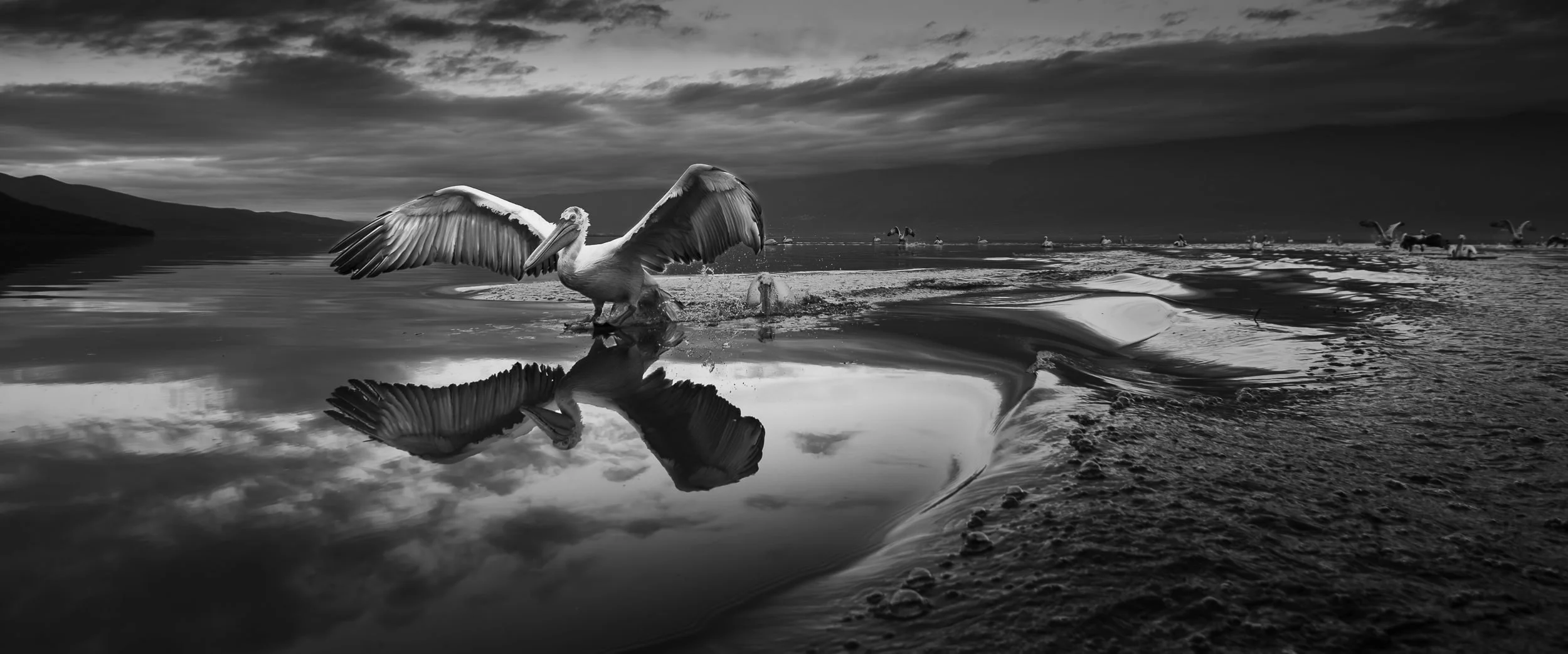
The Kingdom of Pelicans is about returning — going back to the same place, the same species, the same lake across multiple visits and building a body of work over time. The "ongoing" quality is itself the argument: that serious engagement with a subject is not a single trip but a sustained relationship.
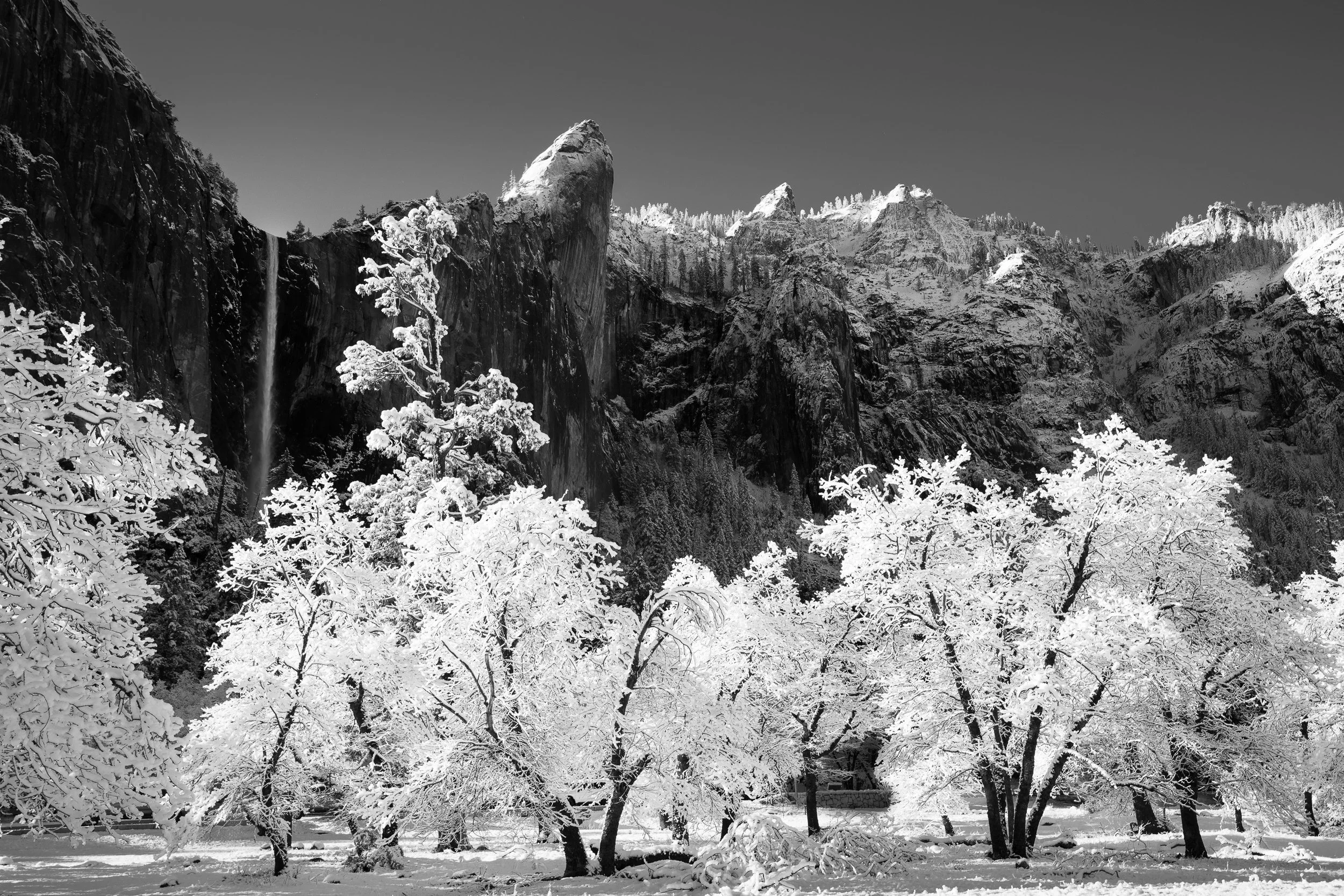
The Incomparable Valley is about seeing a famous place without the weight of its photographic history. Yosemite has been photographed by some of the most important photographers in history — Adams above all. The argument of this series is that the valley still has something to reveal to an outsider who arrives without that legacy and looks at it fresh.
Each of these arguments is different. But the discipline is the same: identify the idea, photograph with intention toward that idea, edit ruthlessly to remove anything that dilutes it, and present the result as a coherent body of work.
Throne of Water
Why galleries care about series
Galleries evaluate artists primarily through their ability to produce coherent bodies of work. This is not arbitrary. It is practical.
A gallery needs to present an artist's work as an exhibition — a curated selection of photographs that fills a room, tells a story, and gives visitors a reason to stay and look. A portfolio of unrelated beautiful images cannot do this. A series can. It gives the gallery curator a narrative arc, a visual consistency, and a clear artistic position to present to collectors and critics.
More importantly, series thinking signals artistic maturity. A photographer who works in series has demonstrated that they can sustain an idea across multiple images, edit with discipline, and articulate what the work means. These are the qualities galleries look for because they indicate an artist who will continue to develop — who will produce new series, deepen their practice, and build a career that justifies the gallery's long-term investment.
For a photographer pursuing gallery representation, the body of work is the application. Not the Instagram following, not the technical skill. The question the gallery asks is: does this artist think in a way that produces exhibitions? Series thinking is the answer.
What this means for collectors
For collectors, understanding series thinking changes how you evaluate and acquire photographs.
A print from a coherent series carries more weight than a standalone image. It has context. It belongs to a larger argument. When you hang it on your wall, it is not just a beautiful photograph — it is a chapter in a story that extends beyond the frame. The collector who owns The Carry owns a specific moment in a specific argument about motherhood and survival in the Maasai Mara. That context makes the print more meaningful to live with and more valuable as a collectible.
Collectors who understand series also make better acquisition decisions. They can evaluate whether a photographer's work has the coherence and depth that supports long-term value — or whether it is a collection of attractive singles with no underlying structure. They can identify artists who are building careers versus artists who are producing inventory. And they can build their own collections with intentionality, acquiring prints that form conversations with each other rather than competing for attention on the same wall.
The most serious collectors start with what moves them and then learn to see the architecture behind what they love. Understanding series is a significant part of that education.
How to recognise series thinking
When you are evaluating a photographer's work — whether for purchase, for a gallery submission, or for your own practice — here are the signals that distinguish series thinking from portfolio thinking:
A clear, articulable idea. The photographer can explain what the series is about in a sentence or two. Not the subject — the idea. "Elephants" is a subject. "The relationship between elephants and the river that sustains them" is an idea. If the photographer cannot articulate the idea, the work may look like a series but function as a portfolio.
Images that gain meaning from each other. Look at any single photograph from the series, then look at it alongside the others. Does it become more interesting in context? Does it reveal something that the standalone image does not? If the photographs are equally effective alone and in context, they are not a series. They are a group.
Visible editorial discipline. A strong series implies the existence of photographs that were cut — images that did not serve the argument. If every photograph in the portfolio feels like it belongs, the photographer has probably edited well. If the work feels bloated or uneven, the editing may not have been rigorous enough.
Consistency of vision, not just style. Style is how things look. Vision is how things are seen. A series has a consistent way of seeing the subject — a point of view that runs through every image. This is deeper than using the same camera settings or the same colour palette. It is about approaching the subject with a consistent set of questions and concerns.
A title and a statement. Serious series have names. They have artist statements. These are not formalities — they are evidence that the photographer has thought about the work as a unified project, not just a set of images that happen to share a subject.
The work behind the work
What most people do not see when they look at a photographic series is how much of the work is invisible. The days in the field that produced nothing usable. The thousands of frames that were edited down to a dozen. The photographs that were loved and cut because they did not serve the idea. The conversations with printers about how the tonal range of one image needs to complement the tonal range of the next when they hang together on a wall.
This invisible work is the difference between producing photographs and producing art. It is what galleries evaluate, what collectors respond to, and what sustains an artist's practice over years and decades.
And it all starts with a simple shift in thinking. Not what should I photograph? but what is this body of work about?
That question changes everything that follows.
Explore the collections: View all limited edition fine art photography collections →
Interested in a print? Submit a print enquiry →