

The Heart of the Wild: Field Notes from the Maasai Mara
The Maasai Mara is the most photographed wildlife landscape on Earth. Millions of images have been made here. Every angle of every animal in every light — dawn to dusk, wet season to dry, from the Great Migration to a single lion on a termite mound. If you have seen a photograph of African wildlife, there is a good chance it was made in the Mara.
So when I went to Kenya in 2023, I knew I was walking into a place where the camera had already been. Thoroughly. The question was not whether I could photograph lions. Anyone can photograph lions in the Mara. The question was whether I could say something with them that had not already been said.
I did not know the answer when I arrived. I knew it by the time I left.
Portraits, not documents
The distinction came to me early in the trip and stayed for the rest of it. I was not there to document lions. I was there to make portraits.
The difference matters. A document records what an animal looks like — its species, its behaviour, its habitat. It serves science or journalism or tourism. A portrait does something else. It tries to capture what the animal is. Not the fact of it, but the presence of it. The weight and mood and character that makes one lion different from every other lion.
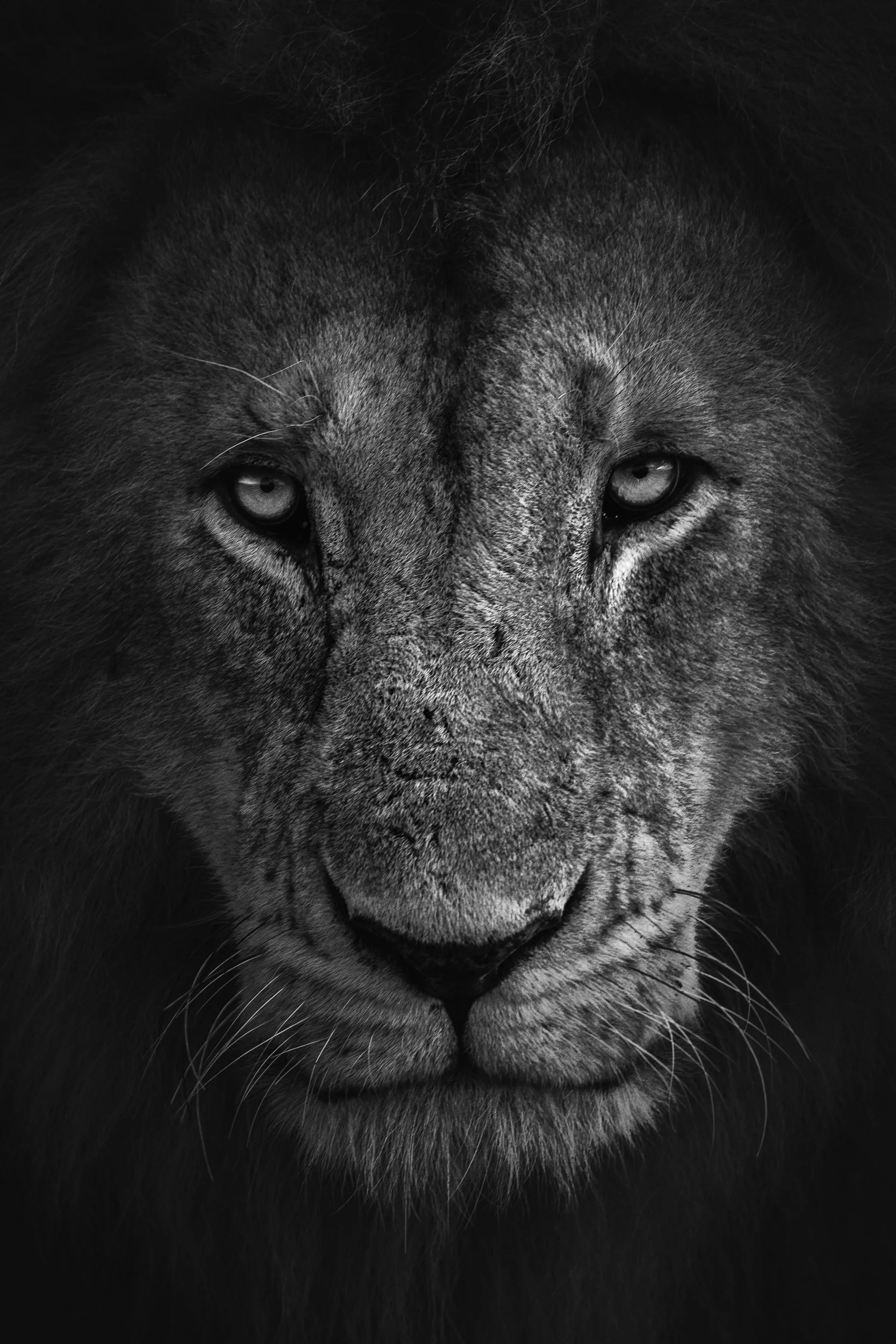
Eye contact is always at the top of my list when I photograph a wild animal, especially for a portrait. The eyes tell stories stronger than any written copy. For The Long Gaze, I wanted everything stripped down to the face and the look. Technically simple. Emotionally the hardest thing to get right.
What that lion's eyes gave me was presence. Not calm, not warning, not tiredness. Just the fact of him being there, fully, in the moment I was photographing him. Most animals do not give you this. They give you a glance, a reaction, a look that is already on its way somewhere else. He held the gaze long enough for me to compose, focus, and make the frame. That is rare. And that is what separates a portrait from a record — the animal's participation in the making of the image.
The darkness around the face is the mane absorbing almost all the light, which is what mane does at the right angle. I did not fight it. I let the black close in around the face so there was nowhere else for the eye to go. A portrait does not need negative space in the literal sense. It needs somewhere for the viewer to land. In The Long Gaze, the landing is his eyes.
What the wounded lion taught me
Not every photograph in the series is quiet.
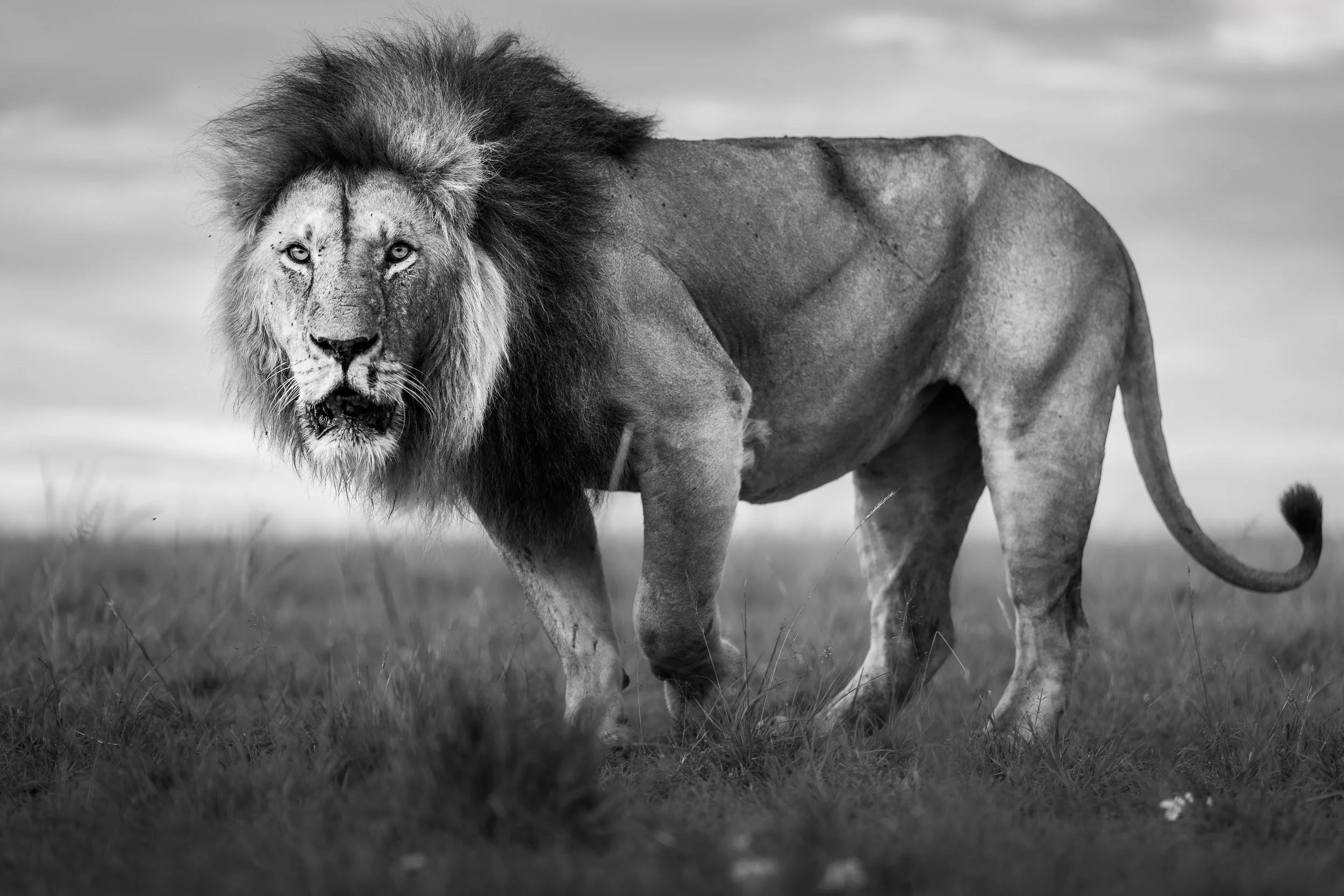
Unbroken is the image of a male lion who was limping. Something had injured one of his feet and he was struggling to walk with it. I watched him coming toward the vehicle, one foot hard to put down, and he kept coming anyway. Wounded but still moving forward.
I wanted the full body for this one. Most of my lion work is tight on the face, but this was not a face story. This was a body story. The full frame tells you what you need to know — the lean muscle, the scars, the injured foot, and still the head held up and the eyes forward. I worked from a low angle in the vehicle so he would fill the frame with the whole of him and none of it would be hidden.
This is not a photograph about a lion. It is a photograph about what you do when you cannot do what you normally do. He kept walking. Slowly, painfully, but forward. That is all any of us can do in the bad moments — the ones where the work is harder than we want it to be, where the body is not cooperating, where something has gone wrong and there is no quick way out. You move forward. You do not wait to feel better before you move.
I do not photograph wildlife to document it. I photograph it because the natural world shows us things about ourselves if we watch closely enough. Sometimes the lesson is in a mother carrying her cub. Sometimes it is in a wounded lion who will not stop walking.
Fractions of a second
The Mara teaches you something about time. You wait whole mornings for a lion to walk into the right light or look the right direction. Hours of nothing happening. Hours of watching an animal sleep, or eat, or stare at a horizon you cannot see. Patience, in this work, is not a virtue. It is the job.
And then the moment arrives, and you have fractions of a second to make the frame.
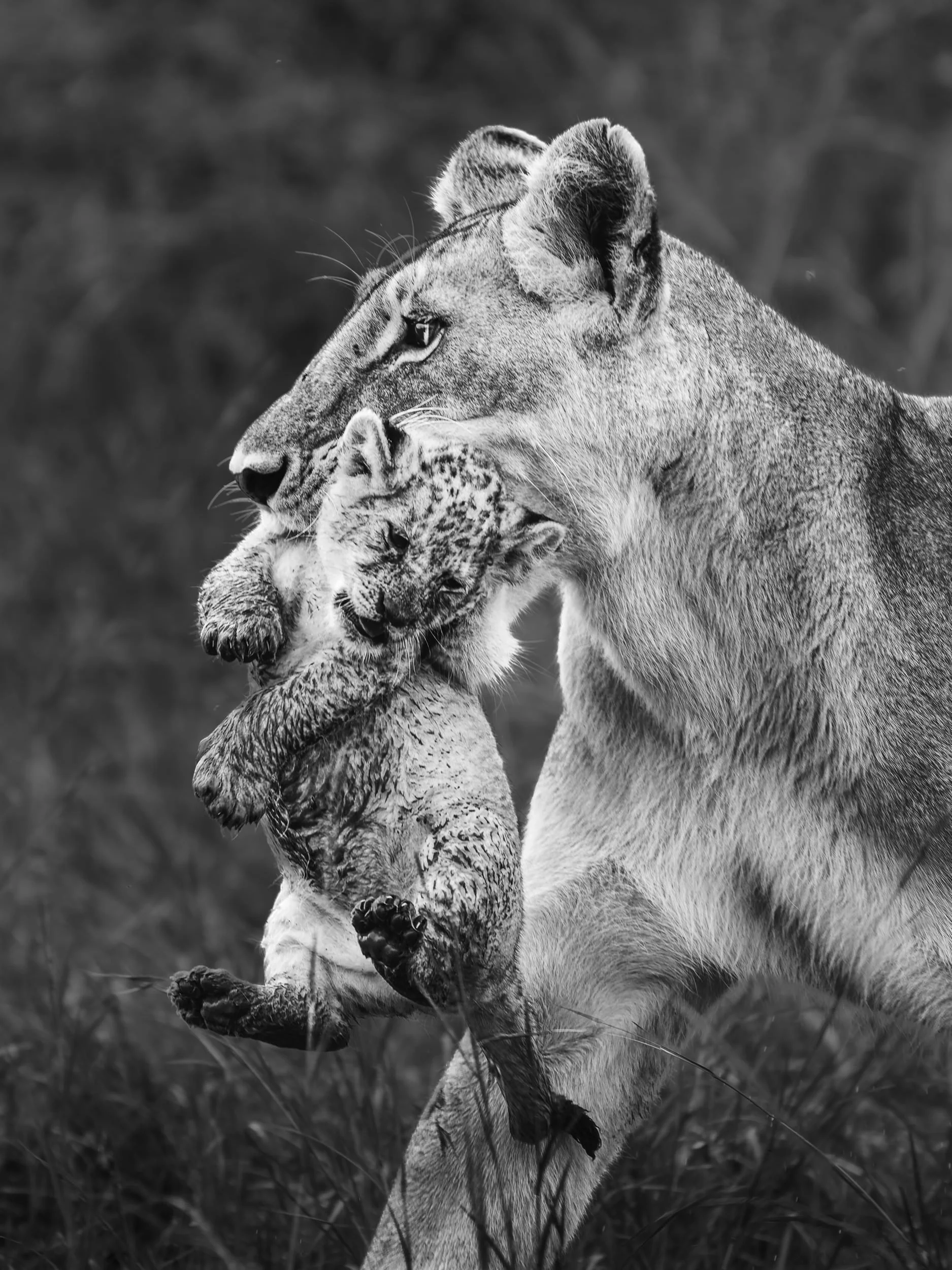
The Carry exists because of this contradiction. A mother lioness with her cub in her mouth — few things in nature carry stronger emotion. But the emotion alone is not the photograph. The photograph is the gesture. The specific alignment of the walking with the faces, the way the mother's profile and the cub's body fall into the same line for a fraction of a second before the next step breaks it.
I wanted to show it from close. Close enough to feel like you are walking next to her. Her eyes in side profile, calm and forward. The cub's body loose in her grip, paws hanging, head turned. That alignment held for almost no time at all. Most frames from those seconds did not work. This one did.
Patience is what gets you in the right place. Speed is what gets you the frame. Without both, you are looking at an image you almost made. The two things sound contradictory but they are not. They are the same discipline expressed in two different timeframes.
The guide who made it possible
I need to say something about Jamlick.
Jamlick is a Masai guide — someone who understands animal behaviour at a level that years of reading and watching documentaries cannot approximate. He knows when to move, when to stop, and when not to interfere. In the wild, access alone means nothing. Understanding is everything.
Mama — the photograph of a mother lioness with her young cub at her side — would not exist without him. The encounter happened on the final morning of the trip, on the way back to camp, with little time to spare. Within the hour, we were leaving the Mara. Jamlick knew the behaviour: a mother keeping her cub apart from the pride in those first days, hidden and under constant watch. He read the landscape and put us in the right place at the right time.
The encounter lasted only a few moments. Easy to miss. The photograph was made during a brief stage in the cub's life — before it joined the pride, when the mother carries everything. Protection. Teaching. Responsibility. The surroundings demanded her awareness. The cub stayed near her side while she absorbed everything beyond it.
Opportunities like this do not repeat themselves. You cannot come back tomorrow and find the same cub in the same light with the same mother in the same mood. The photograph either happens or it does not. Jamlick understood that as well as I did.
I say this because wildlife photographers sometimes talk as if the work happens between them and the animal alone. It does not. It happens between you, the animal, and the people who know the land well enough to bring the two together. That collaboration is not a footnote. It is part of the work.
Why black and white again
The Heart of the Wild is a black and white series, like Echoes of Chobe before it. The reasons overlap but they are not identical.
In Chobe, I chose black and white to strip the elephants out of their Botswana postcard — to remove the travel-photography associations and force the eye onto form and presence. In the Mara, the motivation was similar but the challenge was different. The Mara is the most visually iconic wildlife landscape in the world. Golden light, green grass, dramatic skies — the colours of the Mara are so familiar they have become a brand. Every safari brochure, every wildlife documentary, every Instagram reel uses them. The colour palette is so loaded with associations that it can overwhelm the subject.
Removing colour removed the postcard. What remained was the animal. The texture of skin and mane. The weight of a body in motion. The geometry of a mother carrying her cub. In black and white, the lions are not Mara lions or African lions or safari lions. They are simply lions — stripped to their essence, presented as subjects worthy of study and contemplation in their own right.
This is the thread that runs through all my African work. Not documentation — interpretation. Not specimens of a place, but presences that transcend the place. The monochrome is not a style choice. It is a philosophical position.
From Chobe to the Mara
Echoes of Chobe was my first African wildlife project. It taught me how to think in series — how to edit with discipline, how to build a body of work from a single trip. That story is told elsewhere on this site.
The Heart of the Wild is the second. It carries everything Chobe taught me, but the subject is different. Chobe was about elephants and water — about the relationship between a species and the landscape that sustains it. The Mara is about individual animals. Portraits. Moments. The character and emotion that live in a single animal's face or body or gesture.
If Chobe taught me patience, the Mara taught me speed. If Chobe taught me to see in series, the Mara taught me to see in fractions. Both projects are built on the same foundation — the argument that wildness persists, that wild animals carry meaning, and that the right photograph can make that meaning permanent.
Explore the collection: View The Heart of the Wild — limited edition fine art photography from the Maasai Mara →
Interested in a print? Submit a print enquiry →