

Photographing Iceland in Black and White: Landscapes Stripped to Their Essence
Most of my work is about animals — their presence, their behaviour, their relationship with the places they live. When I pick up the camera, I am almost always pointing it at something alive.
Iceland has no wildlife in the way that Botswana or Kenya does. No herds. No predators. No dramatic encounters between species. What Iceland has is landscape — and landscape so raw, so elemental, so stripped of anything human that it feels alive in a way that most landscapes do not.
That is why I went. Not to photograph scenery. To photograph something that felt as present and as forceful as the animals I am used to working with. And what I found was a place that demanded a different kind of seeing — slower, more structural, more attentive to the weight of silence and the passage of time.
A landscape that behaves like a subject
Most landscapes sit still. They are beautiful, and they are patient, and they wait for you to compose and expose and move on. Iceland does not do this. The weather changes constantly. Light arrives and leaves without warning. Wind reshapes the scene between frames. The landscape is not passive — it is an active participant in the making of the photograph, and if you try to control it, you lose.
I have always been an observer. I think this is why I fell in love with photography in the first place. Watching rather than directing. Letting moments unfold on their own. In Africa, this means waiting for an animal to move, to turn, to give you the gesture that makes the photograph. In Iceland, it means the same thing — except the subject is a glacier, or a coastline, or a mountain emerging from cloud.
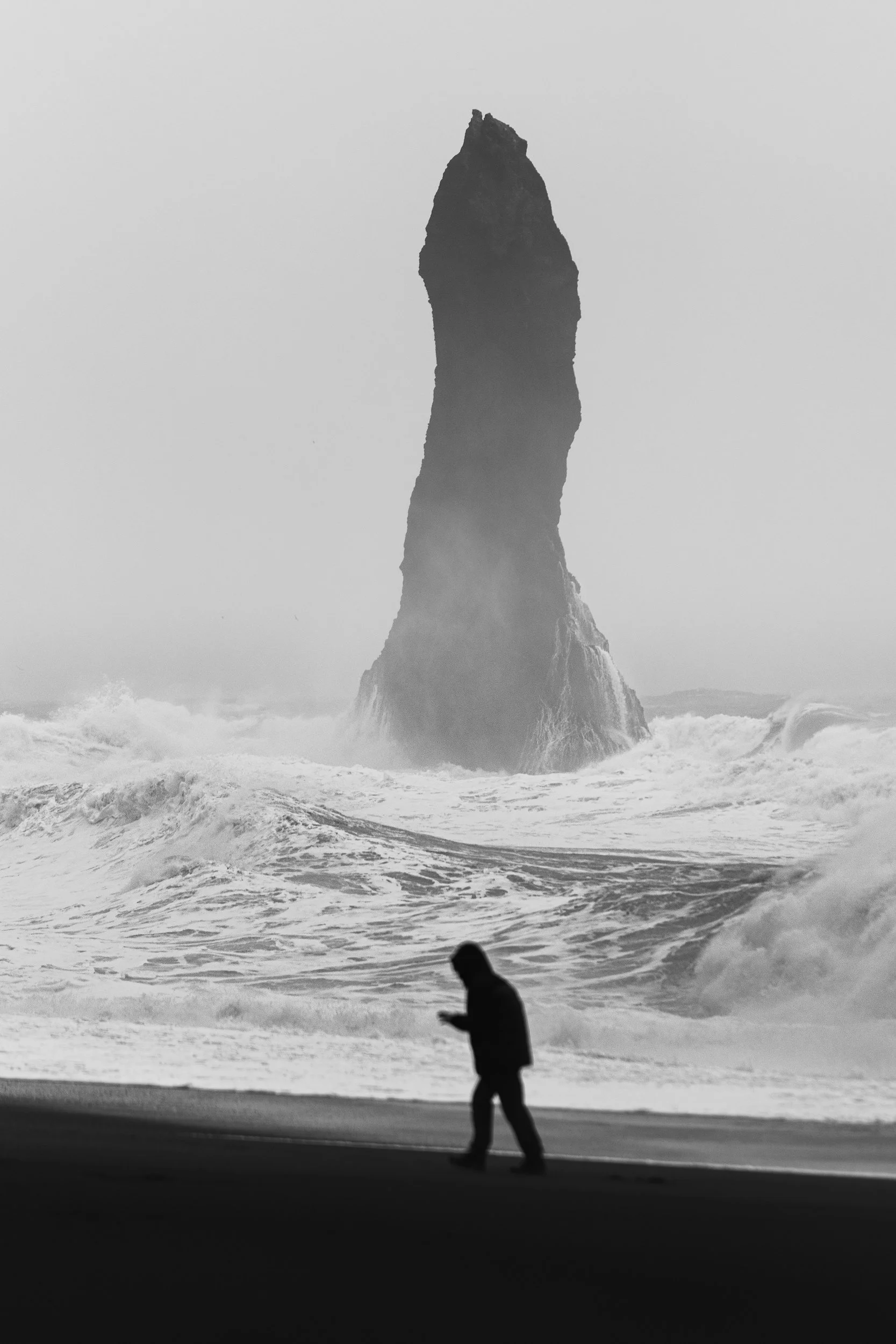
For Alone — a photograph of a solitary rock rising from a restless sea, with a single human figure passing through the frame — I stepped back and let the elements take their place. Wind, scale, and distance did the work for me. The scene felt complete and restrained. The human figure is not the focus. It is a measure of scale — temporary against something that endures. That relationship between the permanent and the passing is what Iceland keeps showing you, whether you are looking for it or not.
Why black and white was instinctive
I did not plan to shoot Iceland in black and white. The decision arrived the way artistic decisions often do — not through analysis but through recognition. When I looked at the colour files during the edit, they were beautiful. The blues of the glacier ice, the black volcanic sand, the grey-green of the moss on old lava fields. Beautiful, and wrong.
Wrong because the colours were doing too much. They were telling the viewer where they were — Iceland, Northern Europe, volcanic island — before the photograph could tell them what they were looking at. The colour was information. And information was competing with feeling.
Black and white removed the information. What remained was structure. The bones of the landscape. The relationship between light and mass, between weight and emptiness, between the sky and the ground and the thin line where they meet. In monochrome, a glacier is not a blue thing in a cold place. It is a form — layered, textured, shaped by forces that operate on timescales the human mind cannot naturally comprehend. That is what I wanted to show.
This is the same logic that drives the black and white in Echoes of Chobe and The Heart of the Wild. Colour locates the subject in a place. Monochrome liberates it from the place and lets it exist as form and presence. In Chobe, this turns elephants from Botswana postcard animals into sculptural presences. In the Mara, it strips lions to their essence. In Iceland, it turns landscapes into architecture — structures built by time and pressure and the slow work of forces we can name but not quite imagine.
The glacier and its retreat
Glacier's Song is the photograph in this series that carries the most weight for me — and not only because of the composition.
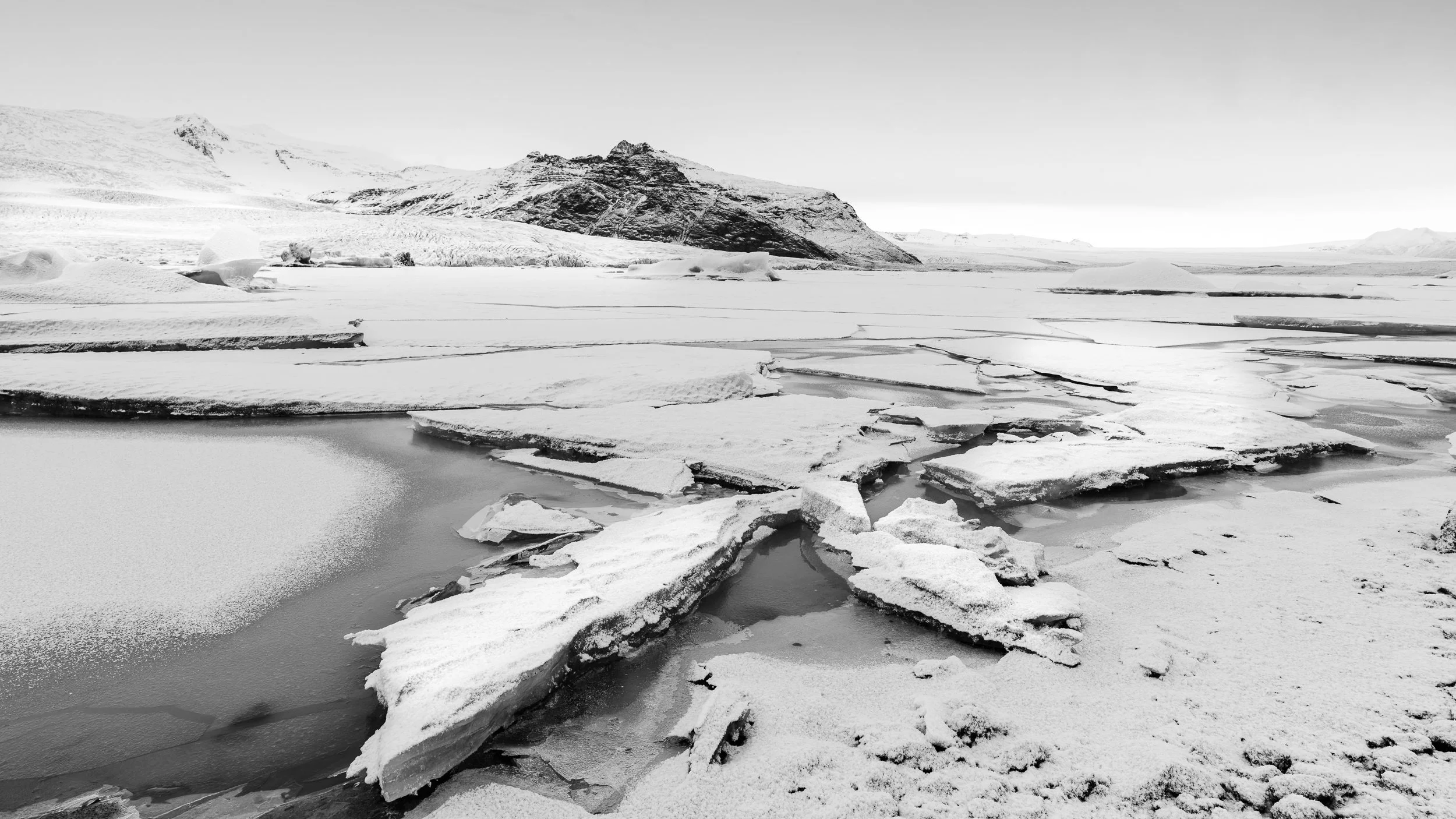
Photographing a glacier in Iceland had been on my list long before the trip began. When you stand in front of something that vast, the challenge is photographing it without the composition becoming messy. I chose a position that allowed the scene to unfold in layers — the melted ice in the foreground, the glacier forming the middle ground, and the bare mountain rising behind it. Structure and depth existing together.
But the experience carried something else. People living in the area described a steady and measurable retreat of the glacier over the years. The change is not abstract. It is visible, recorded, and increasingly difficult to ignore. What appears permanent is slowly changing before our eyes.
This is where my landscape work connects to my wildlife work in ways I did not anticipate. In Africa, the case I make is that wildness persists — that elephants still gather, that lions still hold the plains, that the wild world is here and worth protecting. In Iceland, the case is more complicated. The glaciers are still here — monumental, powerful, ancient. And they are retreating. Both things are true at the same time. The photographs do not resolve this tension. They hold it.
Glacier's Song serves two purposes for me. One is to exist as a fine art print, intended to hold its presence within a space. The other is quieter — to acknowledge the fragility of places that appear permanent, yet are slowly changing.
Structure as artistic decision
What interested me most about Iceland as a photographic subject was the problem of composition. Wildlife photography gives you a subject — the animal is the focal point, and everything else in the frame exists in relation to it. Landscape photography does not have this anchor. There is no animal to draw the eye. There is only land, sky, and the relationship between them.
This forced me to think differently about how I build a frame. In Iceland, I was composing with layers, lines, and tonal weight rather than with a living subject at the centre. The foreground had to do work. The middle ground had to do work. The sky had to do work. Every part of the frame needed to earn its place — because without a subject to carry the viewer's attention, any weakness in the composition becomes immediately visible.
In Glacier's Song, this meant building the image in three distinct layers — the melted ice in the foreground leading the eye inward, the glacier wall forming the weight of the middle ground, and the bare mountain behind it providing scale and closure. Remove any one of those layers and the photograph collapses into a postcard. With all three present, the image has depth that rewards repeated looking — the kind of depth that works as a print on a wall, not just as an image on a screen.
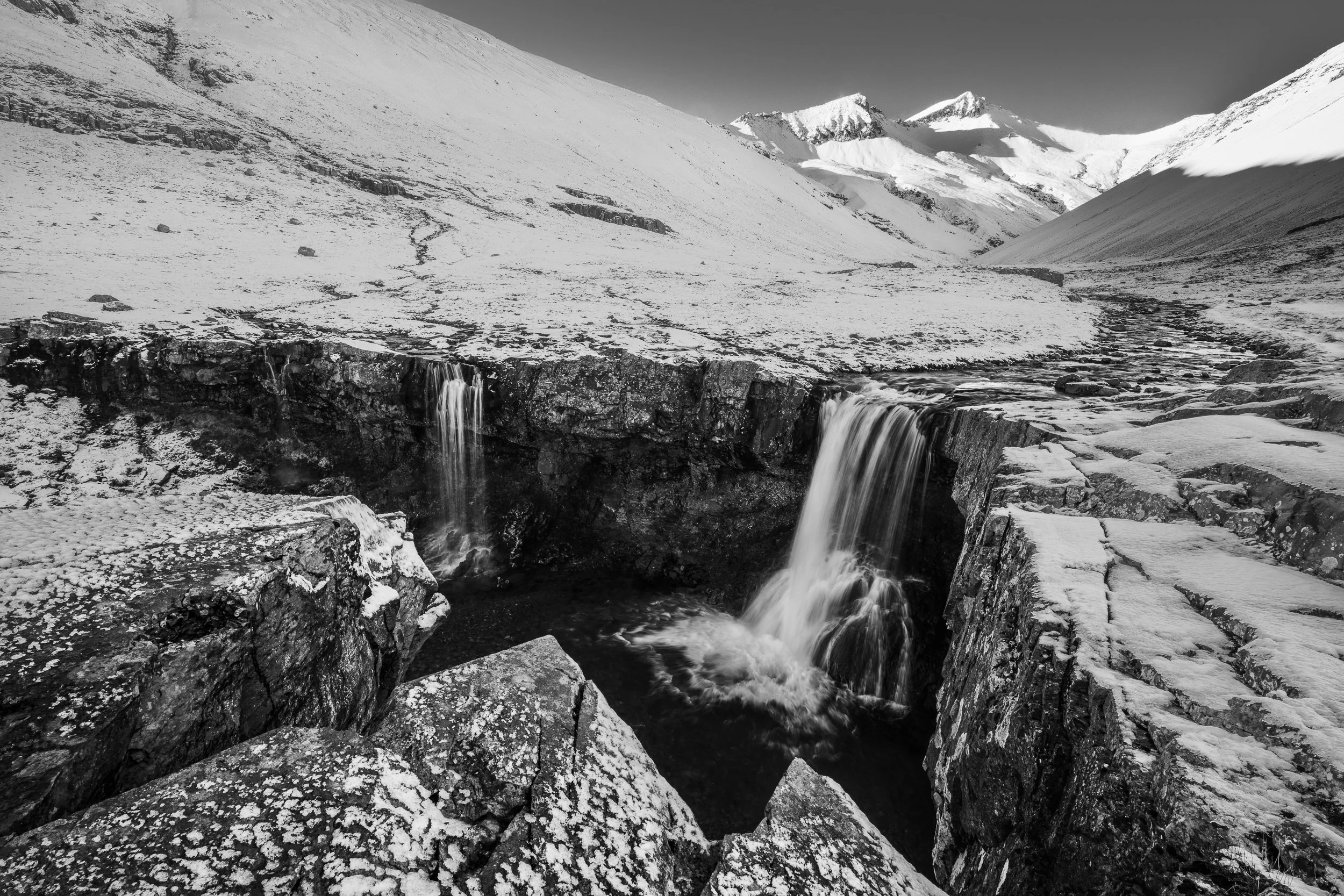
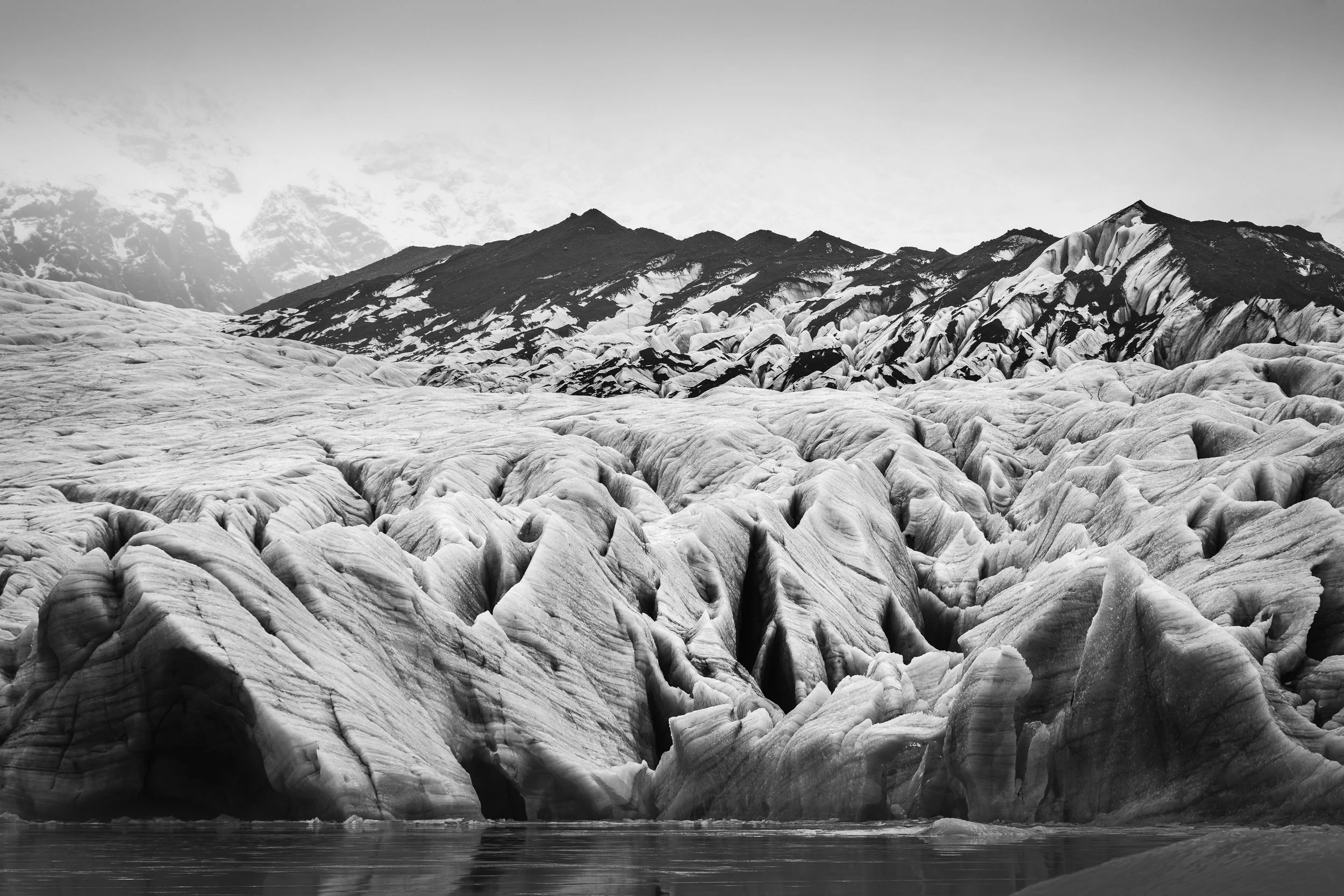
The same structural thinking runs through the rest of the series. In Spirit of the North, the composition is built on the relationship between a dark volcanic foreground and a mountain emerging from cloud — two masses separated by a band of light. In Veins of Ice, the structure is closer to abstraction — patterns of frozen water that read almost as drawing, line and texture without obvious landscape reference. Each photograph solves the composition problem differently, but the underlying discipline is the same: every part of the frame must justify its presence.
This is the discipline that landscape photography teaches, and it has improved my wildlife work since. When I returned to photographing animals — first in The Kingdom of Pelicans and later in The Heart of the Wild — I was more conscious of what surrounded the subject. The negative space, the tonal relationships, the structure of the scene beyond the animal itself. Iceland taught me to see the frame as a whole rather than as a subject against a background. That shift is permanent.
A different kind of wildness
The Land of Ice sits differently in my body of work than the other collections. There are no animals. There is no conservation narrative in the direct sense. There is no encounter between photographer and living subject. What there is, instead, is a conversation with the land itself — with its age, its power, its indifference to the human presence that moves through it briefly and leaves no mark.
This is still wildness. Not the wildness of predators and prey, but the wildness of geological time. Of forces that created the landscape over millennia and will continue reshaping it long after every photograph of it has faded. Iceland reminded me that wildness is not only found where animals gather. It is found wherever the natural world operates on its own terms, without asking permission or offering explanation.
There are moments in life when you feel alone. Iceland has a way of taking that feeling and showing you that solitude is not the same thing as emptiness. Standing in front of a glacier, or a black sand beach, or a volcanic plain that stretches to every horizon — you are alone, yes. But you are alone in the presence of something enormous. Something that has been here far longer than you and will remain long after you leave.
That is what these photographs try to hold. Not the beauty of Iceland, though it is beautiful. Not the drama, though it is dramatic. The scale of it. The weight. The quiet fact that the world was here before us and does not need us to continue.
I brought that feeling home and printed it on paper that will last longer than I will. That seems like the right response to a place like this.
Explore the collection:View The Land of Ice — limited edition black and white photography from Iceland →
Interested in a print? Submit a print enquiry →