

The Wildness That Remains: African Wildlife Photography as Proof, Not Elegy
There is a dominant story in wildlife photography right now. It goes like this: the wild world is dying. The animals are vanishing. The landscapes are shrinking. Every photograph is a record of something that will soon be gone — a last look, a final testament, a beautiful goodbye.
I understand this story. I have read the data. I know the numbers. African elephant populations are a fraction of what they were a century ago. Lion ranges have collapsed. Habitat disappears every year at a rate that is difficult to comprehend. The crisis is real, and the photographers and artists who tell that story are doing important, courageous work.
But it is not my story.
My work is not elegy. It is not mourning. It is not a eulogy delivered over the body of the natural world. My work from Africa is proof — evidence, made visible and physical and permanent — that wildness still exists. That it is powerful. That it is beautiful. And that it is worth every effort to protect.
This is not optimism. Optimism is easy and often lazy. This is something harder: the deliberate choice to show what remains instead of what has been lost. To make photographs that argue for the value of the living world, not the tragedy of its decline.
The elegy tradition
Wildlife photography has a long and honourable tradition of bearing witness to loss. Nick Brandt's work is the most powerful example. His photographs of East African wildlife — elephants, lions, giraffes — are monumental, intimate, and devastating. They carry the weight of a world being erased. His later projects place taxidermied animals in industrial landscapes and climate refugees beside construction sites. The message is clear and unflinching: this is what we are doing. Look at what we are destroying.
Brandt's work matters. It has shaped how an entire generation thinks about wildlife and conservation. His partnership with Big Life Foundation has produced tangible results in anti-poaching and habitat protection. The elegy is not empty — it drives action.
But the elegy has become the default register for serious African wildlife photography art, and that is a problem. When every photograph of an elephant is framed as a last photograph, something shifts in the viewer's psychology. The animal becomes a symbol of loss rather than a living presence. The wild becomes past tense even while it is still present tense. The viewer's emotional response moves from engagement to grief, and grief — over time — produces helplessness, not action.
I have watched this happen. I have seen people look at powerful wildlife photographs and say, with genuine sadness, "It's so beautiful, but it's all disappearing." And then they move on. The sadness does not convert into anything. It just sits there, heavy and inert.
I wanted to make work that produces a different response.
Proof, not documentation
There is an important distinction between what I do and wildlife documentation. A documentary photographer records what is there — species, behaviour, habitat, population. The goal is accuracy and completeness. The photograph serves science, journalism, or education. It is valuable. It is necessary. It is not what I do.
African wildlife photography as art does something different. It does not record the animal. It interprets the animal. It takes the raw encounter — the light, the landscape, the animal's presence in a specific place at a specific moment — and filters it through an artistic vision that says something the camera alone cannot say.
What my work says is this: the wild world is still here. It is not a memory. It is not a relic. It is alive, powerful, and present.
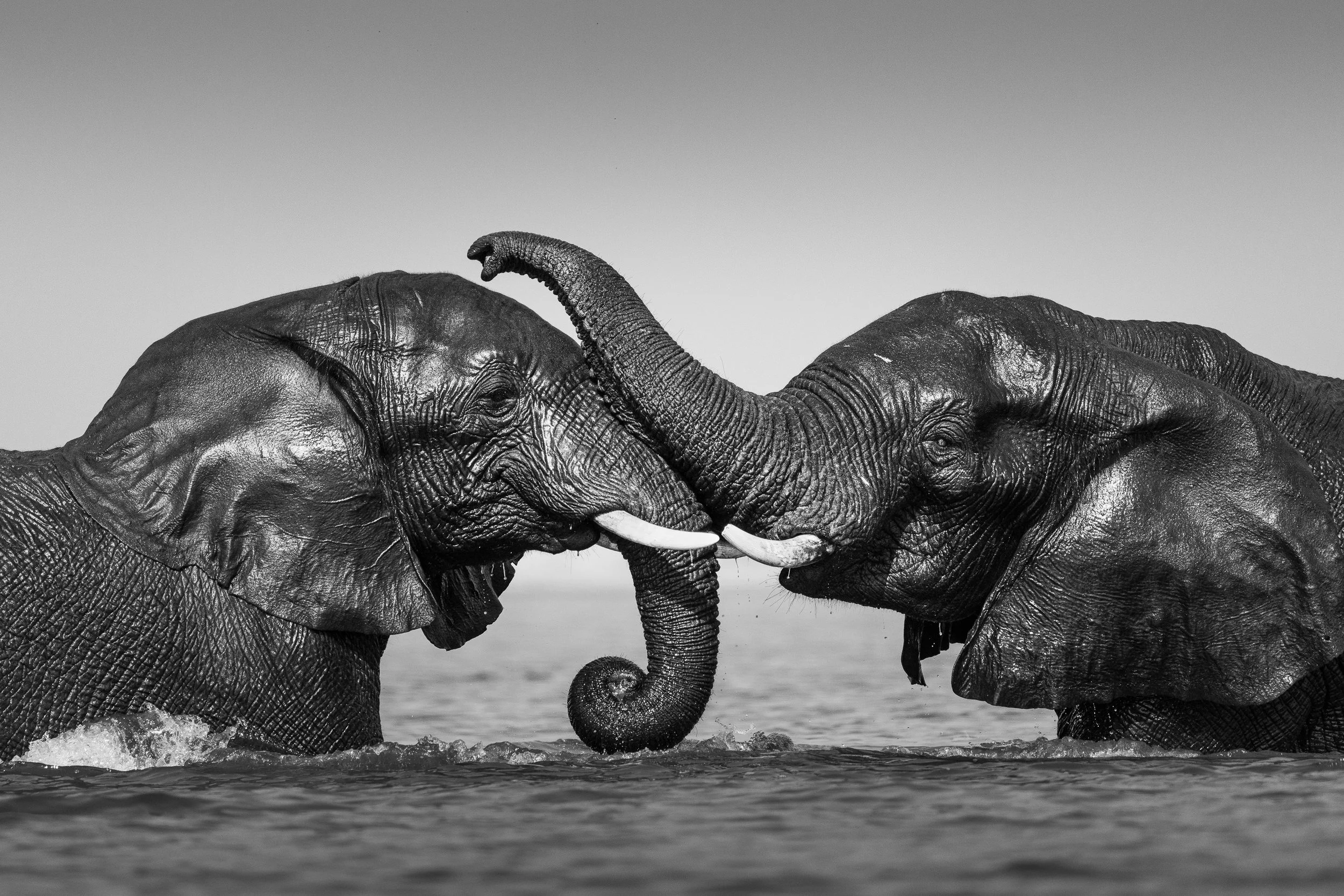
When I photograph elephants at the Chobe River, I am not making a record of elephants that might soon be gone. I am making a case — in light, in tonality, in composition, in the physical weight of an archival print — that these animals are magnificent now. That their presence in the landscape is a fact, not a fading echo. That the right response to seeing them is not grief but awe. And that awe, unlike grief, makes people want to protect what inspired it.
This is what I mean by proof. The photograph is evidence that wildness persists. And presenting that evidence as art — as something worth living with, worth hanging on a wall, worth paying serious money for — is itself an argument about the value of the wild world.
Why hope matters more than mourning
I am not naive about the state of the natural world. I have been to places where the damage is visible, where the absence of animals that should be there is deafening. I do not pretend that everything is fine. Everything is not fine.
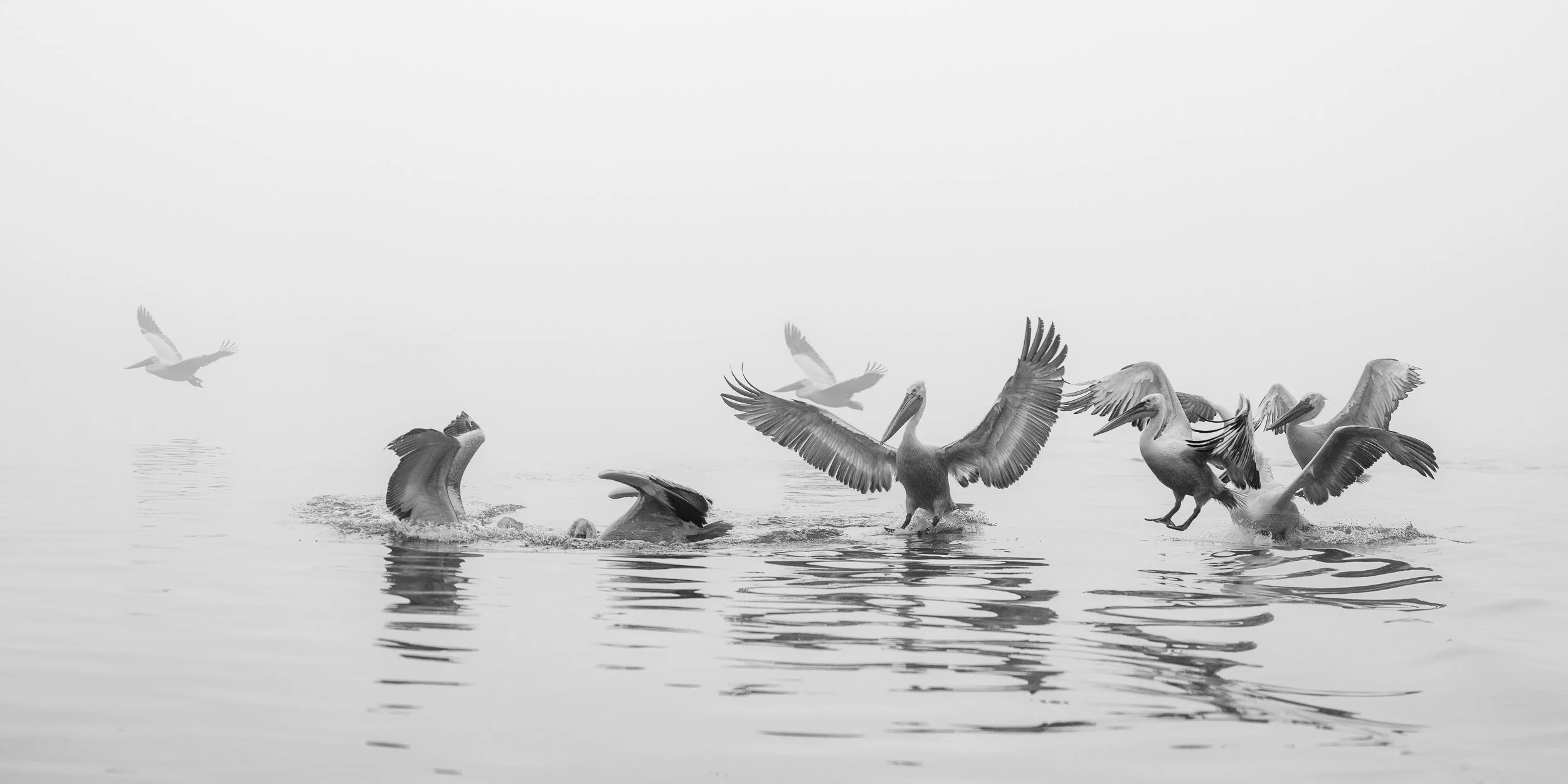
But I have also been to places where the wild world is holding on. Where conservation efforts are working. Where elephants still gather in numbers that take your breath away. Where pelicans descend on a Greek lake in a spectacle that has been happening for centuries and is still happening now. Where a valley in California looks exactly as it did when the first photographs of it were made over a hundred and fifty years ago.
These places exist. They are real. And they deserve art that honours their reality — not art that pre-emptively mourns their loss.
The conservation argument is practical as well as emotional. Research in environmental communication consistently shows that fear-based and grief-based messaging produces short-term attention but long-term disengagement. People who feel overwhelmed by the scale of a crisis tend to shut down, not act. Hope-based messaging — messaging that shows what is possible, what is working, what is worth protecting — produces more sustained engagement and higher rates of action.
This does not mean ignoring the crisis. It means framing the response differently. When a collector hangs a fine art wildlife print in their home, I want them to feel connected to the living world — not mourning it. I want the photograph to be a daily reminder that wildness exists and that their decision to support it, even through the act of collecting, matters.
Where this work fits
African wildlife photography art has a lineage. It stretches from the earliest expedition photographs through Peter Beard's chaotic, collaged diaries of 1960s Kenya, through David Yarrow's dramatic, high-production encounters with predators, through Nick Brandt's elegiac monuments to a vanishing world. Each of these artists responded to the wild in a way that reflected their time and their temperament.
Beard was a romantic documenting the beginning of the end. Yarrow is a showman who uses spectacle to generate attention and charitable funding. Brandt is a mourner whose anguish is sincere and artistically profound. All of them have contributed to how the world sees African wildlife.
My contribution is different. I am not documenting an ending. I am not staging a spectacle. I am not mourning. I am making the case — quietly, persistently, photograph by photograph — that the story is not over. That the elephants of Chobe are not the last elephants. That the pelicans of Kerkini are not the last pelicans. That wildness is not a style or a nostalgic idea but a present-tense reality that can be encountered, experienced, and brought home as art.
This positioning is deliberate. In a market where most serious wildlife photography art leans toward darkness, loss, and ecological grief, choosing hope is itself a creative and philosophical statement. It is not the easier path. Elegy is emotionally compelling and commercially proven — people respond to tragedy. But hope, done honestly — without sentimentality, without naivety, without pretending the crisis does not exist — reaches a different kind of collector. One who wants to live with beauty that affirms life rather than mourns its passing.
The photographs as arguments
Every collection I produce is an argument in this larger case.
Echoes of Chobe is an argument about the persistence of elephants — their social bonds, their physical grandeur, their relationship with the river that sustains them. The photographs are in black and white because monochrome strips away the decorative and leaves the essential. Without colour, the elephants become form, texture, and presence. They are not pretty. They are powerful.
The Kingdom of Pelicans is an argument about returning — about a place I go back to again and again, watching the same species in the same landscape across seasons and years. The pelicans of Lake Kerkini are not exotic. They are not endangered in the dramatic way that elephants are. But they are wild, and their annual gathering is a spectacle that depends on the health of the ecosystem. The photographs argue that wildness is not only found in Africa. It is found wherever we choose to see it.
The Land of Ice is an argument about landscapes as living entities — glaciers and volcanic plains that are changing, yes, but that are still here, still powerful, still capable of stopping you in your tracks. The Incomparable Valley is the same argument in a different register — an American wilderness that has been photographed for over a century and still has something new to reveal to an outsider looking at it without the weight of its photographic history.
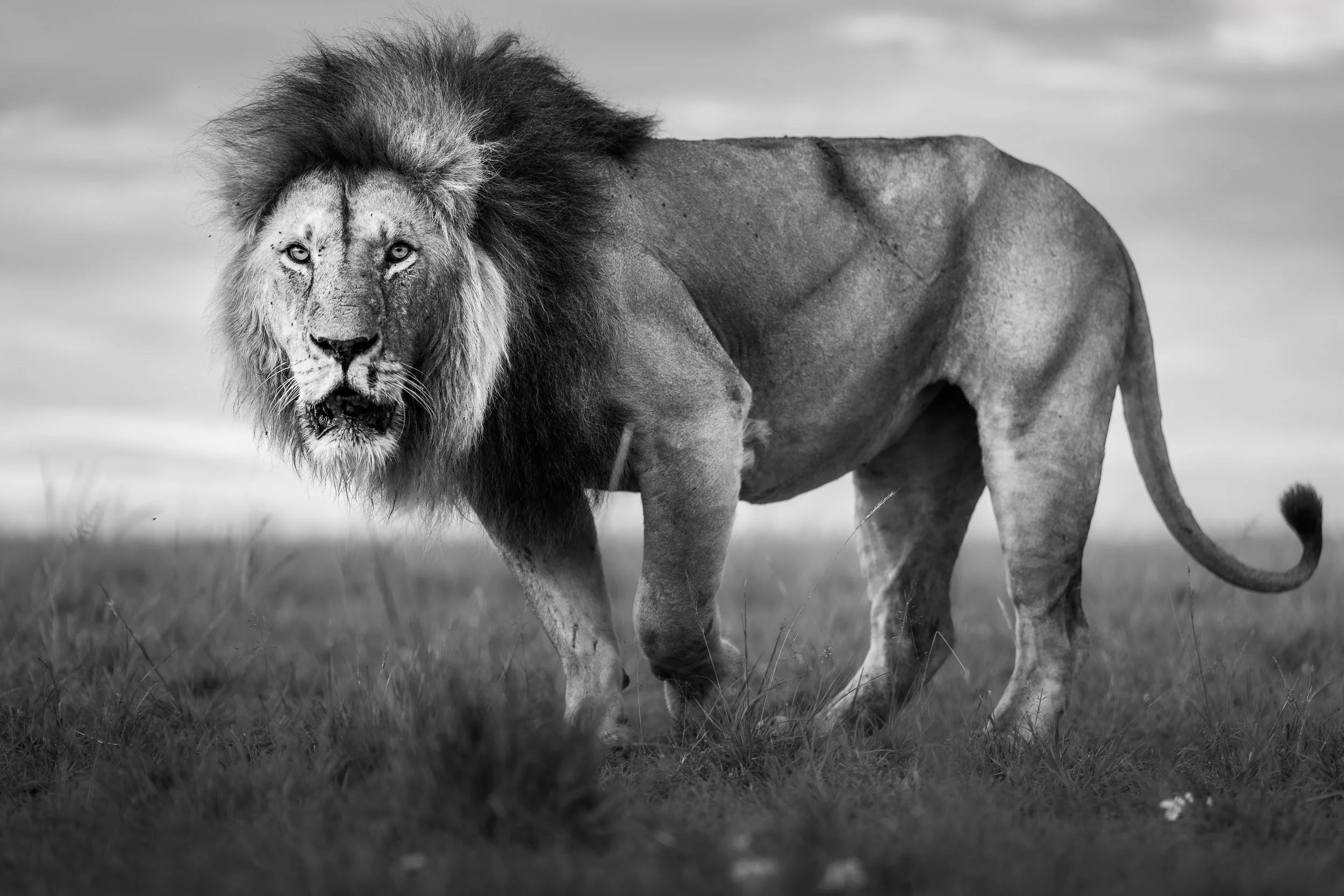
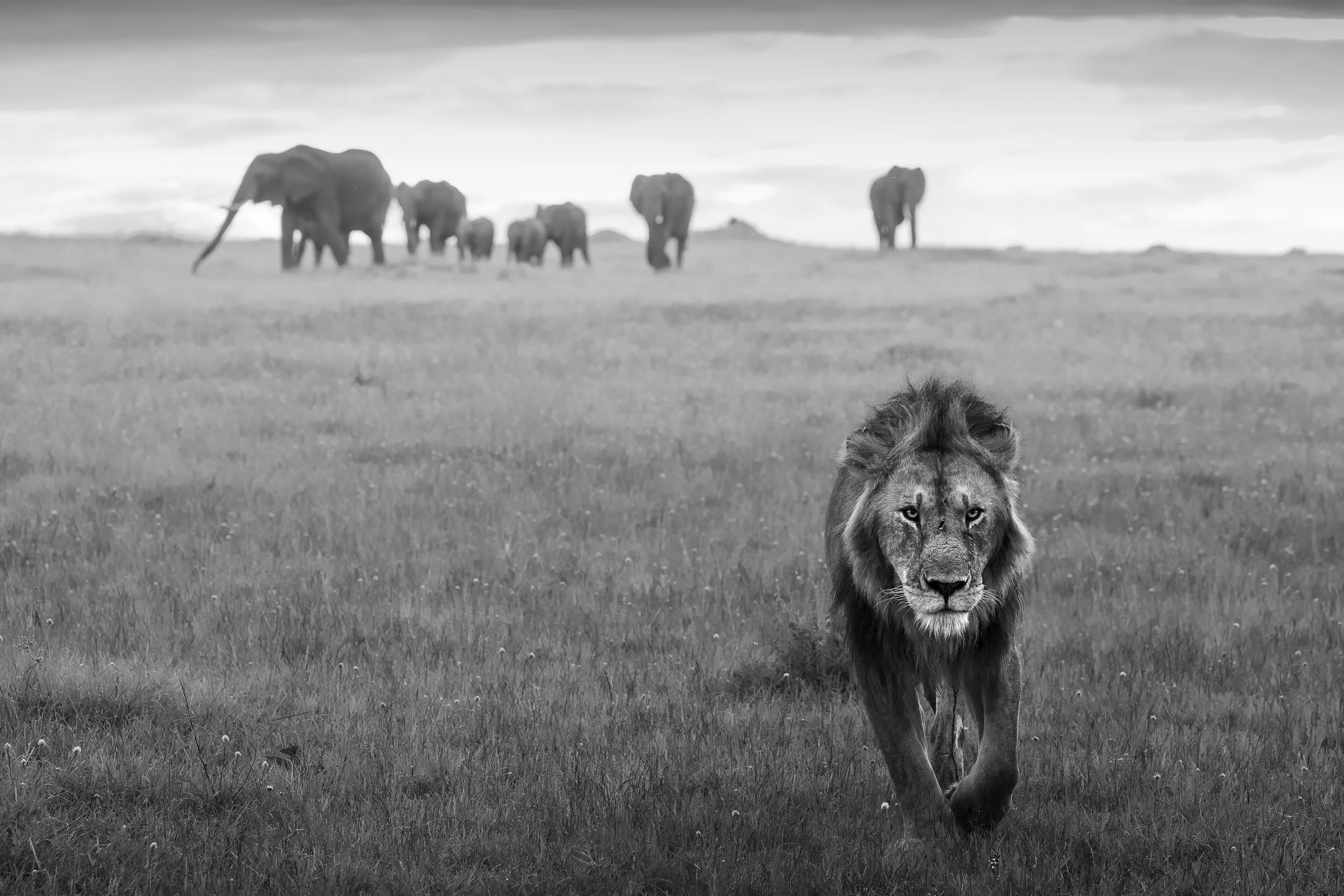
The Heart of the Wild is the most recent of these arguments — a black and white series from the Maasai Mara in Kenya, one of the great wildlife stages of Africa. Where Echoes of Chobe is about the river and the elephants drawn to it, The Heart of the Wild is about the open plain and what survives on it. Lions, herds, predators and prey moving across grass and dust under enormous skies. The photographs do not catalogue species. They study presence — the way a single lion holds the weight of a landscape, the way a mother carries her young through a place that has not changed in the way humans measure change. The Mara is one of the places where wild Africa is still wild Africa. The photographs are the case for keeping it that way.
Together, these collections say something that no single photograph can say on its own: wildness is not a single place or a single species. It is a quality of the world that persists wherever we pay attention to it. And the act of paying attention — deeply, carefully, with artistic intention — is itself an act of preservation.
What collecting this work means
When I say that buying a fine art wildlife print is more than a purchase, I mean it literally. It is a declaration. The collector is saying: I believe this matters. I believe the wild world has value. I want evidence of that value in my daily life — not on a screen, not in a museum I visit once a year, but on my wall, in my home, where I see it every morning.
This is different from buying decoration. A decorative photograph asks nothing of the person who owns it. A fine art print from a body of work built on the idea that wildness persists asks the collector to participate in that idea. To accept its premise. To carry it forward.
Every limited edition print that enters a private collection extends the argument. It takes the case for wildness out of the gallery and into someone's life. And when the edition sells out — when the last print of 25 is spoken for — the argument does not end. It just becomes more concentrated. More valuable. More permanent.
This is the business model, yes. But it is also the artistic model. The scarcity of the edition mirrors the scarcity of what it depicts. A world with fewer wild elephants is a world where a photograph of wild elephants matters more, not less. The print becomes rarer as the subject becomes rarer. That parallel is not accidental. It is the point.
The work ahead
I do not know how this story ends. Nobody does. The wild world may hold on. It may not. The forces pushing against it — development, climate change, human population growth, political indifference — are enormous. The forces defending it — conservation organisations, protected areas, individual commitment, art that makes people care — are smaller but persistent.
What I know is that the work I make is a contribution to the defence. Not a large one. Not a decisive one. But a real one. Every print that hangs on a wall is a small, daily argument that the wild world is worth noticing, worth protecting, worth paying attention to. And in a culture that is relentlessly loud, fast, and distracted, the simple act of stopping — of looking at a photograph of an elephant and seeing not a dying species but a living presence — is itself a form of resistance.
This is what my work from Africa is for. Not to mourn. Not to document. To prove.
The wildness remains. The work is to make sure it stays.
Explore the collections: View all limited edition fine art photography collections →
Interested in a print? Submit a print enquiry →