

The photograph that started all of this was made by someone who had no idea what he was doing. I want to say that first.
Lake Kerkini, northern Greece. Winter, 2021. Before sunrise. It was my first real attempt at photographing animals, and birds were unfamiliar territory. I had an entry-level Sony crop sensor body and a simple Tokina wide-angle lens. Completely wrong equipment by every rule I believed at the time. I thought a serious photograph of an animal needed a long telephoto and a lot of money.
The boat moved slowly across the water. Blue hour. The lake was flat enough to hold the whole sky inside it. And the pelicans came close. Not startled, not performing. Just there, close and unguarded, as if we were sharing the same silence.
One of them landed. The reflection broke the surface. I made the frame.
When I looked at the back of the camera I knew. Light, composition and moment had come together in a way I could not have planned and have never repeated.
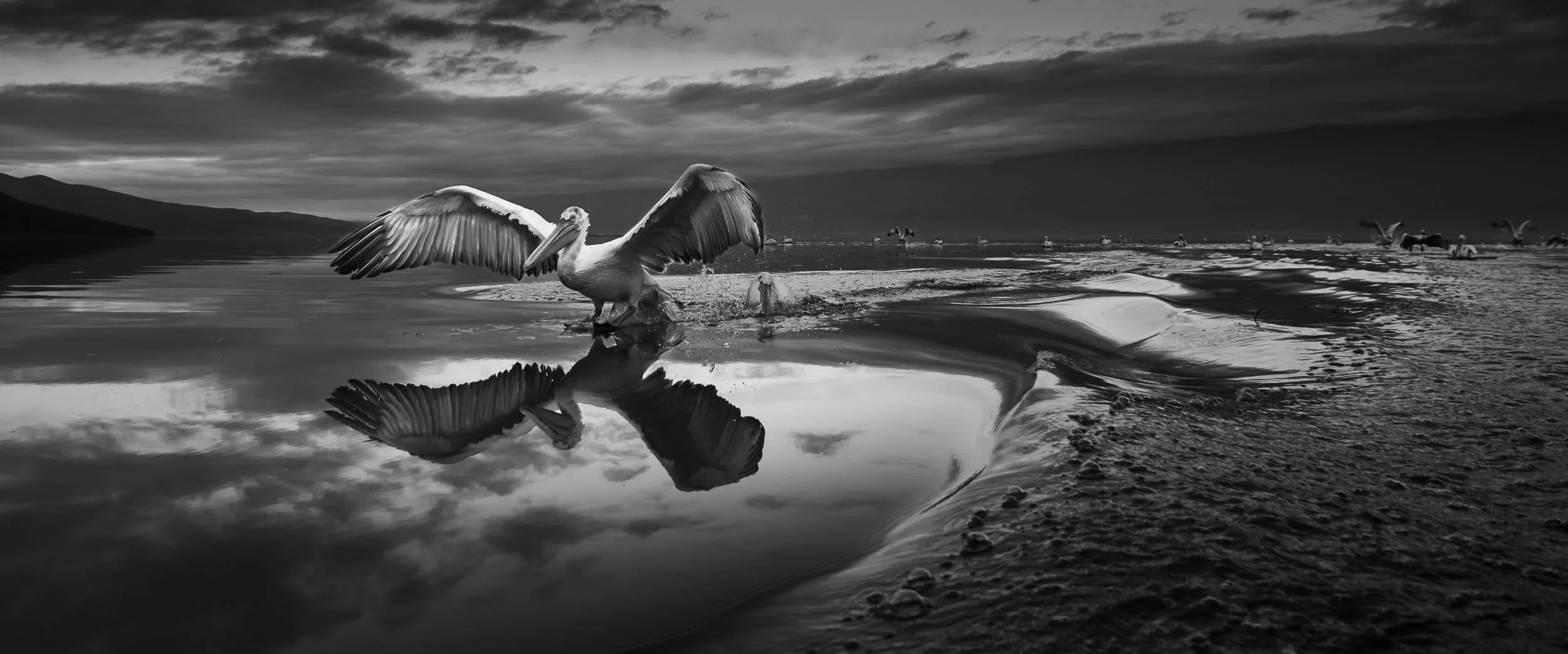
That photograph is called Throne of Water. It taught me the only technical lesson I still care about. A strong photograph does not start with expensive gear. It starts with seeing.
Everything I have made since, in Botswana, Iceland, the Maasai Mara, Yosemite (all collections), starts on this lake.
I am not photographing an encounter
Most photographs of animals are built on the idea of a rare meeting. You travel far, you wait, something extraordinary happens, you press the shutter. The photograph is a trophy of luck.
Kerkini does not work like that, and understanding why took me years.
The fishermen here feed the pelicans through the winter. When a boat comes in with fish, the birds gather on the water and wait. This arrangement is older than my time on the lake. It is the reason the pelicans stay close, the reason they are not fearful, the reason a photograph from three metres away is even possible.
So the boat, the man with the fish, the lake, the birds. It is a system. Not an encounter. I am photographing inside something that was already working long before I arrived and will keep working after I am gone. That changes how you behave. You stop hunting for a moment. You start learning a rhythm.
The First to Rise came out of that. One bird lifting early, wings high, already committed, while the rest stay down with their heads turned toward the fisherman. I have watched that exact moment many times. There is always one that goes before the others.
I do not think you can make that photograph on a first visit. You can be lucky. But you cannot know it is coming.
What returning actually gives you
The Kingdom of Pelicans was made across four winters, 2021 to 2024. Same lake, same boat, same fishermen, mostly the same birds. That repetition is not a scheduling detail. It is the method.
Pelicans gather without any signal I can detect. One lands, then three more, then twenty. Then stillness. Then movement that nobody started. I have watched this shape form and break more times than I can count, and most mornings it does not resolve into anything worth a frame.
Then one morning it does.
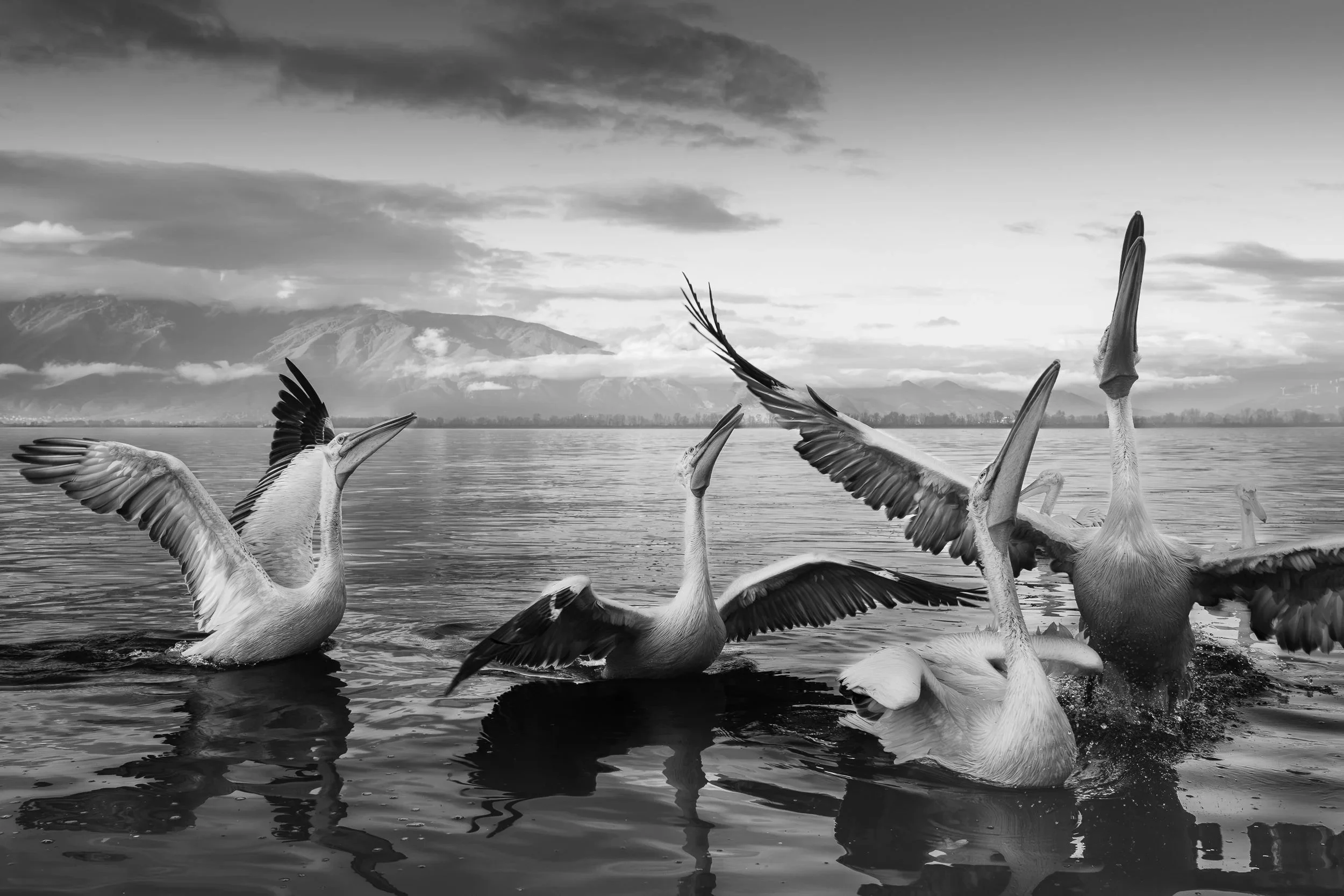
The Assembly looks chaotic when you first see it. It is not. There is an order in there that only the birds understand, and my job was to recognise it in the two or three seconds it held together.
This is what I mean when I talk about working in series instead of collecting single images. A body of work made over years holds information a one-trip project cannot fake. Collectors notice this. So do galleries. I wrote more about it in how fine art photographers build a body of work.
The weight of the bird
The Dalmatian pelican is among the largest flying birds on earth. Wingspan around three metres. People do not really believe this until one passes close to the boat and they feel the air move.
Nothing about its life is light. It has to work to lift. It has to work to land. It has to work to hold its place on a cold lake through winter.
That effort is the subject, more than the species is.
A bird that size cannot settle gently on water. It has to run across the surface as it comes in, wings out, feet striking, body tilted back to brake. For a few seconds it is neither above the lake nor on it. The Race holds that in-between state. The spray, the commitment. Nothing about landing is effortless for them, and they do not hide it.
Then the opposite frame. Sovereign Flight is one bird, close, filling the frame, nothing else in it. The background is empty on purpose. I did not want the species or the behaviour. I wanted the weight of a single bird in the air. One wingbeat should be enough.
And when the whole group lifts at once, the sound is low and huge. Closer to weather than to birds. Wings striking water, air moving in bursts, the entire surface of the lake breaking up at the same time. I photographed The Uprising from low on the boat, wide, because one pelican taking flight is a portrait, but a group taking flight is something else. That frame is about the moment the lake becomes sky.
The morning the fog decided
Photographing large numbers of birds is difficult. When many of them share a frame it turns into noise very fast. Usually I wait for the scene to offer some order.
One morning I did not have to wait. The fog did the work before I did.
It was dense and it stayed. It removed the shoreline and the horizon completely, and the lake became a neutral surface. What was left was only the pelicans and what they were doing. Fishing, lifting, settling. Cut away from everything else.
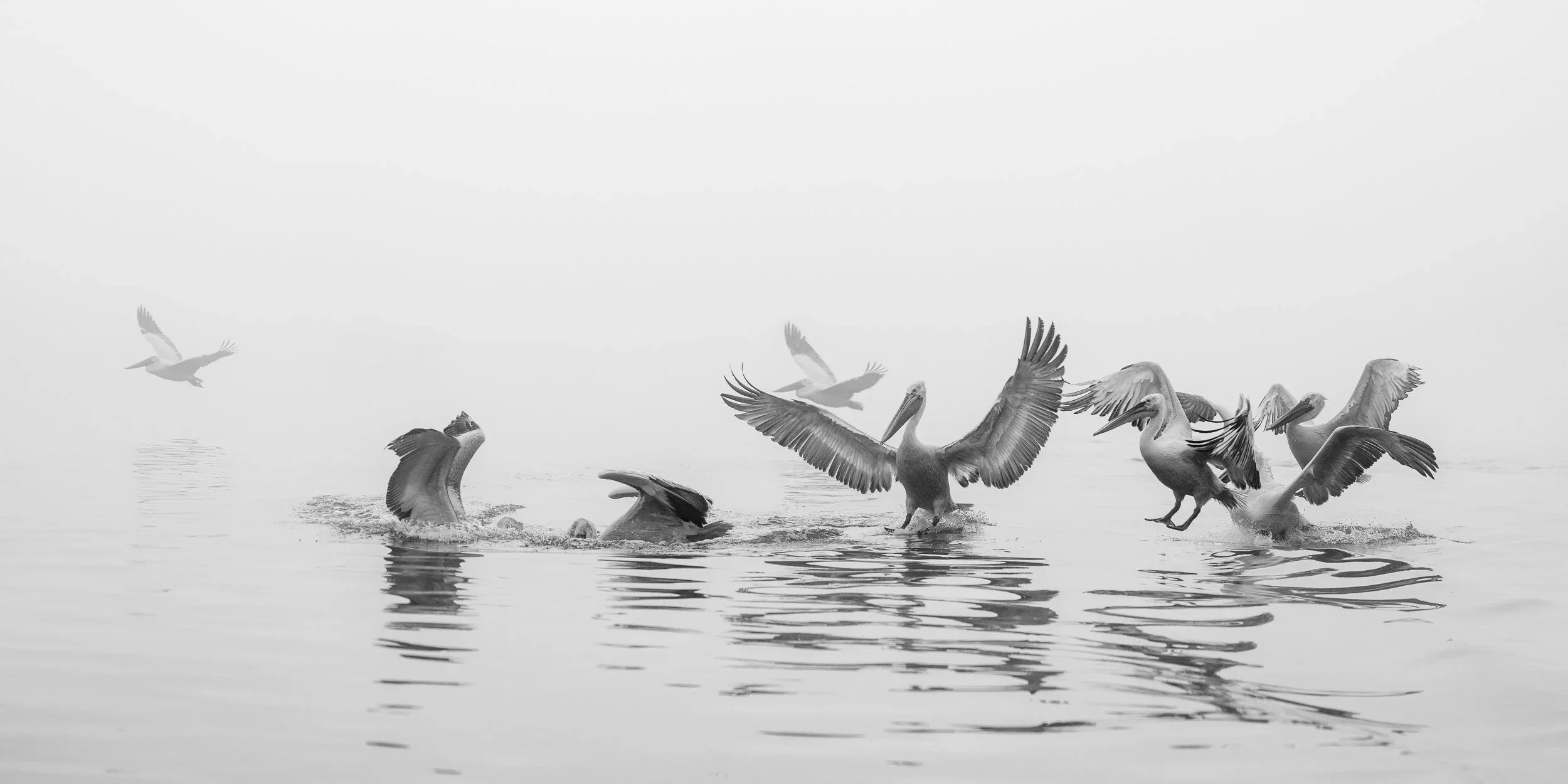
I went with it. Exposed high on purpose, let the mist dominate, pushed the image toward high-key. The light was minimal and the camera was at its limit, but the decision was made in the first minute and I did not change it.
The fog lifted after a while. The scene got sharper and the balance was gone. What stayed with me was that short window where everything felt suspended and the motion stayed gentle. Mist and Motion is the only frame from that morning I kept.
There are also the opposite days, when the water turns to a mirror and everything comes back at you. Birds, sky, mountains, the line of the shore. Tranquil Reign came from an afternoon like that. Two pelicans coming down together, their reflections carrying as much of the image as the birds do. You need timing for photographs like this, but also a cooperation you cannot direct. The animals decide the moment.
Why the whole series is black and white
With Throne of Water I struggled with this. The colour version was strong. I lived with both for a long time.
I chose black and white, and then I chose it for everything that followed.
Removing colour takes the photograph out of time. Attention moves to form, light and gesture, and those do not age the way a colour palette does. At Kerkini specifically, colour would have made these images look like a place. Without it they look like a condition. Cold, quiet, early. That is closer to what being there feels like.
There is a longer argument for this in why monochrome reveals what color conceals, and the practical side of how these prints are actually made is in from field to print.
The lake is not natural, and that is the point
Something I did not know for a long time: Kerkini is man-made.
It was created in 1932, when a dam went across the Strymonas river and flooded what had been marshland. A newer dam replaced it in the eighties. The whole thing exists for irrigation and flood control. Farmland, water management, engineering. Not conservation.
And it became one of the most important wetlands in Europe anyway. Ramsar protection since 1975, now a National Park. The most important wintering site on the continent for Dalmatian pelicans.
Then it nearly went wrong. The spring water level kept rising, and the birds had nowhere to nest. The islets they could have used were going under. So in 2002 WWF Greece and the lake's management body built wooden platforms, set higher than the maximum water level. Within a couple of springs the pelicans were breeding on them. The people working at the lake called it the first recorded expansion of the species' breeding range in more than a hundred and fifty years. Today there are around two hundred and fifty pairs.
Because somebody built a platform.
I think about this on the boat more than I expected to. The lake is an accident of agriculture. The pelicans are here partly because of a decision made in an office. The fishermen who feed them do it for their own reasons, not for the birds. And out of all that, on a cold morning in January, you get a bird with a three-metre wingspan coming down onto still water in front of you.
Nothing about that is pristine. It is better than pristine. It is repaired.
Proof, not loss
Almost every photograph of animals you see now carries the same message underneath it: this is disappearing, look while you can.
I understand why. I do not work that way.
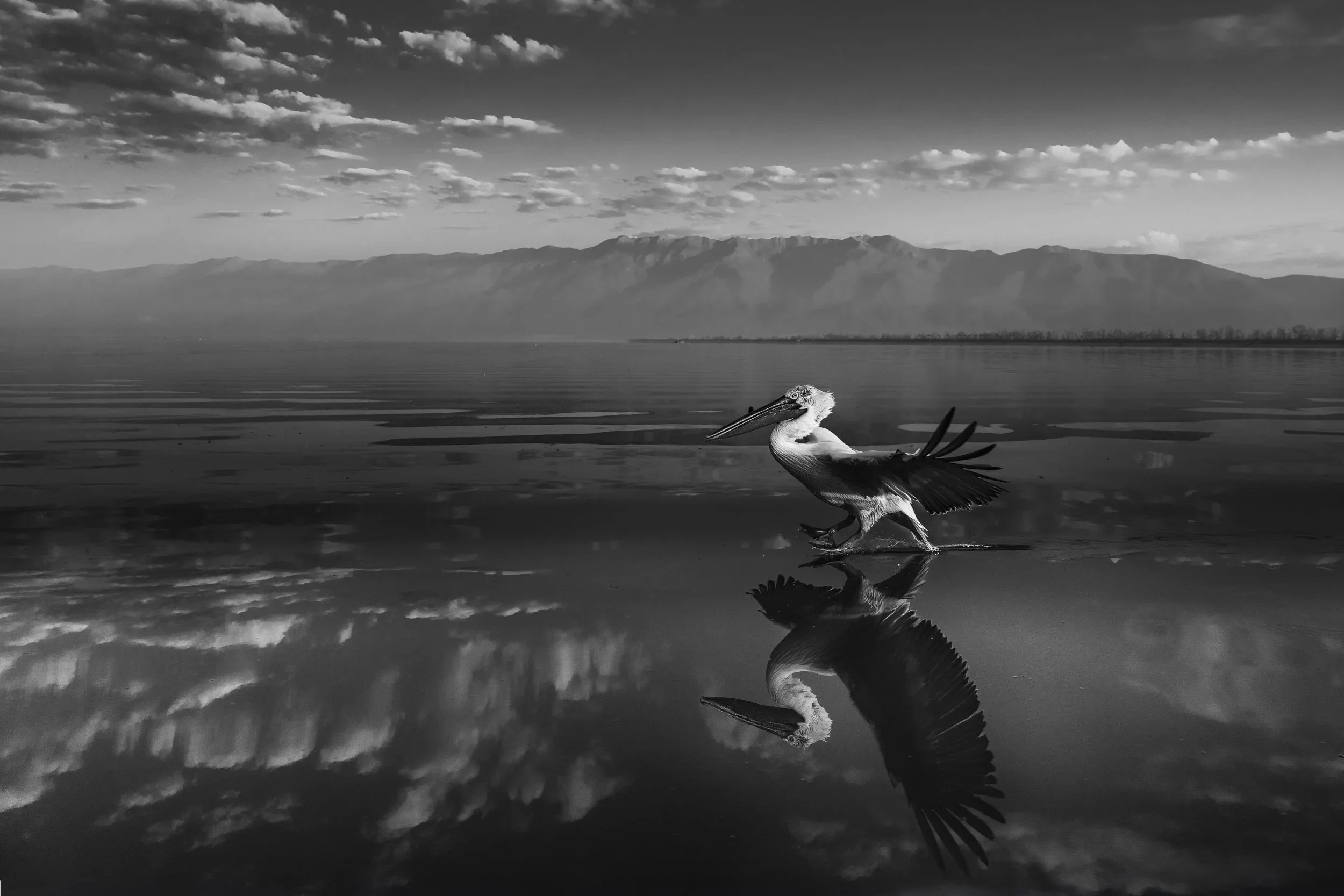
Kerkini is ninety minutes from where I live. Not a remote wilderness, not an expedition. A working lake with fishermen on it. And in the quiet before sunrise, with a bird that heavy coming down onto water nobody has touched yet, what I feel is not loss. It is aliveness. Something old and big doing exactly what it has always done, on its own terms, a few metres from me.
That is what I want these photographs to carry. Not a warning. Proof that it is still happening. Between Worlds says it most directly. One bird, the reflection intact underneath, the moment before the day starts.
These birds have been doing this for far longer than anything we have built. I am going back this winter, and the one after. The series is not finished. I am not sure it ever will be.
Explore the collection: View The Kingdom of Pelicans, limited edition black and white photographs from Lake Kerkini →
Interested in a print? Submit a print enquiry →