

Art That Gives Back: How Buying Wildlife Photography Protects Endangered Species
There is an idea that gets repeated so often in the art world that it has become a slogan: buying art is an act of support. Support for the artist. Support for the subject. Support for the cause.
Most of the time, it is vague enough to be meaningless. But in the specific case of fine art wildlife photography, it can be literally true. A print purchase can fund anti-poaching patrols, habitat protection, community programmes, and the salaries of the rangers who keep endangered animals alive. The money moves. The impact is measurable. The link between what you hang on your wall and what survives in the wild is real.
The problem is that this claim is also often made by people and products where it is not true — where "conservation" is marketing language and the actual dollars never reach the ground. So the question for any serious collector is not whether buying wildlife art for conservation is possible, but how to tell the difference between real impact and comfortable storytelling.
This post is about that difference. What works, what does not, and how to make a purchase that actually matters.
Why photography is particularly well-suited to this
Photography has a practical advantage over other art forms when it comes to conservation fundraising. A photograph can be reproduced at scale without losing its artistic integrity. The same image can be sold as multiple limited edition prints, which means a single donated image can generate significant revenue without forcing the artist to give up an irreplaceable original.
This is why photography has become the dominant medium for large-scale art-for-conservation fundraising. It is a medium built for multiplication. A painter cannot donate the same painting to 100 collectors. A photographer can donate the same image, printed 100 times, and raise $10,000 for a cause from a single artistic contribution. Multiply that across hundreds of photographers, and the numbers get serious.
The other advantage is emotional. Photographs of wildlife are evidence — actual documented presences of actual animals in actual places. When a collector sees a photograph of a lion, they are not looking at an interpretation of a lion. They are looking at a lion that existed, in a moment that happened, photographed by someone who was there. That documentary quality creates a kind of direct witness that painting or sculpture cannot quite replicate. It makes the connection between the art and the cause feel more immediate.
The model that works: Prints for Wildlife
The clearest example of wildlife art for conservation done at scale is Prints for Wildlife, a fundraiser founded in 2020 by photographers Pie Aerts and Marion Payr. The model is simple. Dozens of wildlife photographers donate one image each. The images are sold as limited edition prints at a fixed price — $100 per print. The campaign runs for one month per year. One hundred percent of the proceeds, after printing and handling, goes directly to a conservation non-profit partner.
Since 2020, Prints for Wildlife has raised over $2.5 million. Early editions partnered with African Parks, a conservation organisation that manages more than 20 national parks across 11 African countries. More recent editions have supported Conservation International. Over 380 photographers have participated across the years.
The money has funded measurable outcomes. Ranger salaries. Anti-poaching operations. Community healthcare. Schools. Scholarships. Infrastructure in parks that would otherwise struggle to stay operational. This is not abstract support. It is payroll and fuel and medical supplies, converted from art sales into actual work on the ground.
What makes Prints for Wildlife credible where other "conservation art" initiatives are not is the transparency. The partners are named. The amounts are published. The outcomes are reported. The photographers donate the images, which means there is no commercial intermediary siphoning off the bulk of the funds. A collector who buys a print knows — with reasonable confidence — that their $100 is becoming conservation work, not marketing budget.
What does not work
The opposite of Prints for Wildlife is "conservation art" as a vague positioning statement. You will find it across the online print market. Websites selling wildlife prints with language like "a portion of proceeds supports conservation" — without specifying what portion, which conservation organisation, or how much has actually been donated. Galleries promoting "eco-conscious collecting" without any structural connection to conservation outcomes. Individual artists claiming their work "raises awareness" while raising nothing but their own commercial profile.
None of this is necessarily dishonest. Awareness matters. Public interest in wildlife contributes, in diffuse ways, to political will for conservation. But it is not the same as money reaching the ground. And when "awareness" becomes a substitute for direct funding, the claim of conservation impact gets thin.
Here are the questions I would ask before accepting any claim that a wildlife art purchase supports conservation:
Which organisation receives the funds? A named, verifiable non-profit partner is the baseline. "Conservation efforts" is not an answer. "The David Shepherd Wildlife Foundation" or "African Parks" or "Conservation International" is an answer. If the artist or seller cannot name the partner, the claim is marketing language.
What percentage of the sale goes to conservation? "A portion" can mean anything from 1% to 99%. Serious fundraising efforts specify the figure — and for structured campaigns like Prints for Wildlife, that figure is 100% of proceeds after direct costs. For ongoing artist donations, 10–25% of the sale price is a reasonable range. Below that, the claim becomes symbolic rather than substantive.
How much has been raised to date? This is the accountability question. Established programmes publish their numbers. If the seller cannot tell you how much money has actually moved from art sales to conservation work, they are either too new to have a track record or too uncomfortable with the real figure to share it. Either way, you have information you did not have before.
Is there an external audit or public reporting? Large-scale initiatives like Prints for Wildlife publish annual breakdowns of what was raised and how it was spent. Non-profit partners issue their own reports showing how the funds were deployed. If there is no paper trail, the claim relies entirely on trust — and in charity, trust without verification is how good intentions become bad outcomes.
The individual artist model
Most fine art wildlife photographers are not running large-scale conservation fundraisers. They are individuals working on projects, building collections, and selling limited edition prints to collectors. Their relationship to conservation is usually more personal and less structured than a coordinated campaign.
There are a few ways this shows up. Some photographers donate a fixed percentage of every sale to a conservation partner. Some run occasional limited-edition releases where 100% of proceeds from a specific image goes to a specific cause. Some build ongoing relationships with NGOs — photographing their work, providing images for their campaigns, turning over rights for fundraising. And some make the argument that their artistic work itself is a contribution to conservation, because it shapes how people see and value wild animals.
That last claim is the most contested, and it deserves scrutiny. An artist who makes beautiful photographs of elephants and says "my work is conservation" without any direct funding relationship is making a cultural argument, not a financial one. It is not nothing — how we see wild animals shapes whether we protect them — but it is also not the same as writing a check. Collectors should know the difference.
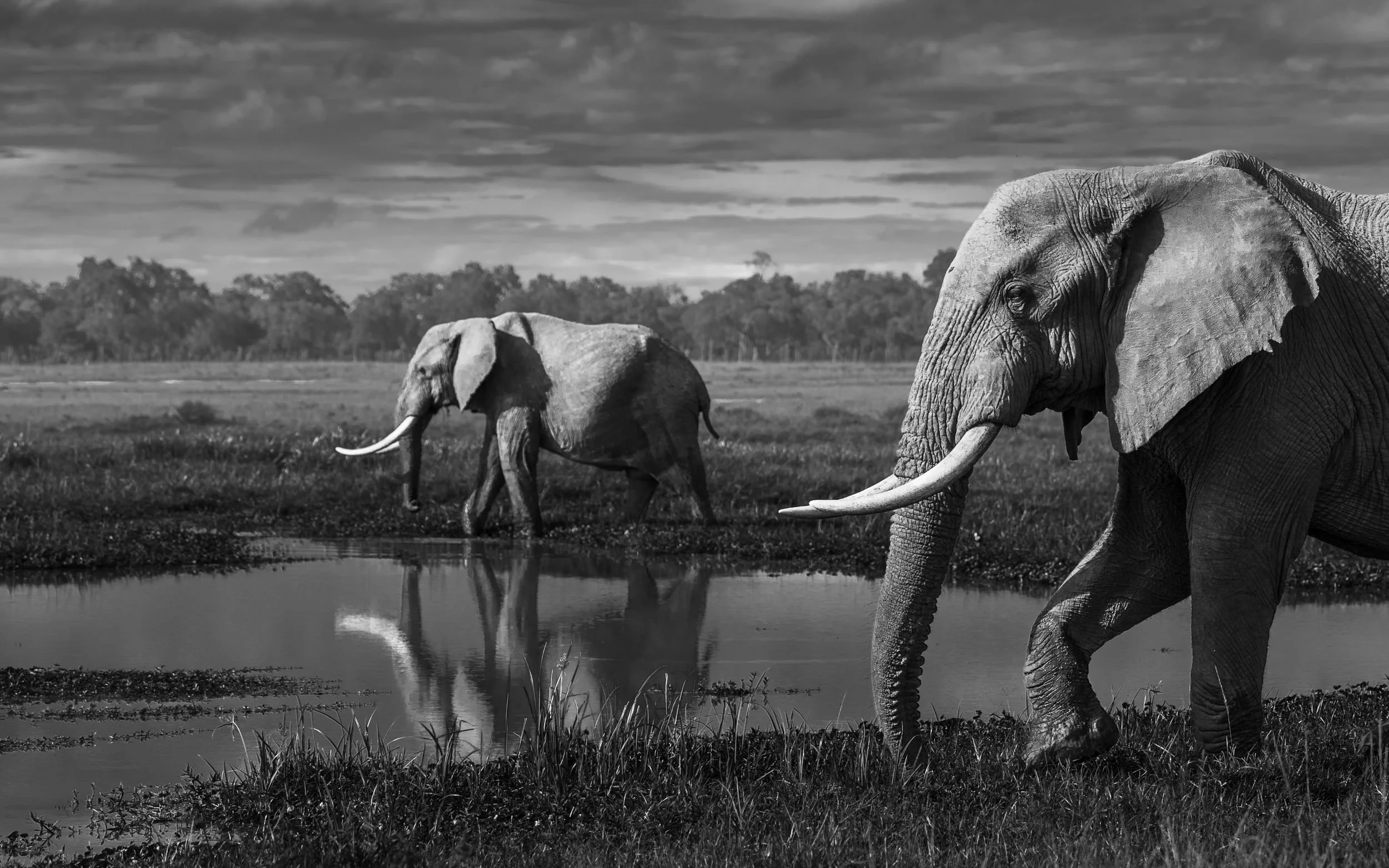
For my own work, I do not claim that every print sale funds a specific conservation programme. I make a different argument. I make photographs of places where conservation is actually working — places like Chobe National Park in Botswana, where protected areas, tourism revenue, and anti-poaching efforts have produced thriving elephant populations, and the Maasai Mara in Kenya, one of Africa's great wildlife landscapes where conservancy models and community partnerships have kept the ecosystem largely intact. The photographs document what good conservation looks like. They make the case — visually, viscerally — that wild places can be saved when the effort is real. That is the contribution I am most comfortable claiming. It is honest about what my work does and what it does not do.
The tourism-conservation link
There is another, less obvious way that wildlife art connects to conservation. The places where serious wildlife photography happens are, in many cases, places where tourism revenue directly funds the protection of the habitat. When a photographer visits a national park in Botswana, Kenya, Zambia, or Rwanda, the park fees, guide wages, lodge payments, and associated spending become part of the economic case for keeping the place protected. Without tourism, many protected areas would struggle to justify their budgets. With it, they can pay rangers, maintain infrastructure, and resist the pressure to convert wild land into agriculture or development.
A fine art photograph from one of these places is, in an indirect way, a product of that economic model. The photographer could only be there because the place was accessible, protected, and populated with animals — which required tourism revenue, which required people who wanted to go and see the animals, which required a cultural sense that the animals were worth seeing. The whole system depends on people valuing wild places enough to fund their protection.
When a collector then buys a fine art wildlife print, they are participating in the cultural side of that same system. They are saying that the wild world has value worth preserving in their daily life. They are extending the reach of the photograph beyond the trip, beyond the park, into the permanent environment of someone's home. That is not direct conservation funding, but it is not nothing either. It keeps the argument alive in places far from the actual animals, and it deepens the constituency for protection.
The honest case for collecting wildlife art
So what should a collector conclude from all this?
First, that wildlife art for conservation is a real thing — when the structure is right. Prints for Wildlife has proven that the model works at scale. Individual artists with transparent conservation partnerships can produce real impact. The link between art and protection exists, and it is measurable when you look in the right places.
Second, that most "conservation art" claims do not meet a serious standard. Vague language, unspecified percentages, unnamed partners, and unreported outcomes are warning signs. A collector who wants their purchase to fund conservation should ask the same questions they would ask of any charitable donation: who gets the money, how much, and what do they do with it.
Third, that cultural contribution matters, even when it is not the same as financial contribution. Art that makes people care about wild animals is part of the ecosystem of protection — not the whole of it, but a real part. A photograph that hangs on a collector's wall for thirty years, seen every day, absorbed into the daily life of the family — that photograph is doing something. It is keeping a certain kind of attention alive. And attention, sustained over time, is the soil from which political will eventually grows.
Fourth, that the most honest photographers will tell you exactly where the line is between the two. They will not claim direct conservation impact where there is only cultural contribution, and they will not undersell cultural contribution by pretending it is nothing. The work is worth what it is worth. The honest claim is the one that holds up.
Buying art as participation
None of this means every wildlife print purchase has to come with a conservation receipt. You can buy a photograph because you love it, because it moves you, because you want to live with it. That is a complete reason. Not every cultural act needs to be justified by a measurable impact on the world.
But if conservation is part of why you are drawn to wildlife art — if you want your purchase to mean something beyond decoration — then understanding the mechanics matters. Find artists whose relationship to conservation is honest and specific. Support structured fundraising efforts like Prints for Wildlife when they run. Ask questions. Read the fine print. And recognise that buying from photographers who make work in protected places, with ecological integrity, is itself a small contribution to the economic case for keeping those places protected.
Every print in a private collection is a small argument that the wild world is worth preserving. Some of those arguments come with a direct financial transfer to conservation work. All of them come with the quieter, longer contribution of keeping wildness present in daily life — in the eye, in the room, in the attention of the person who chose to hang it on the wall.
Both kinds of contribution matter. Neither is a substitute for the other. And a collector who understands the difference is in the best position to make a purchase that actually does what they hope it will do.
Explore the collections:View all limited edition fine art photography collections →
Interested in a print?Submit a print enquiry →